Easton 5mm FMJ
Excellent
Ranked #3 of 8 arrows
$187.99
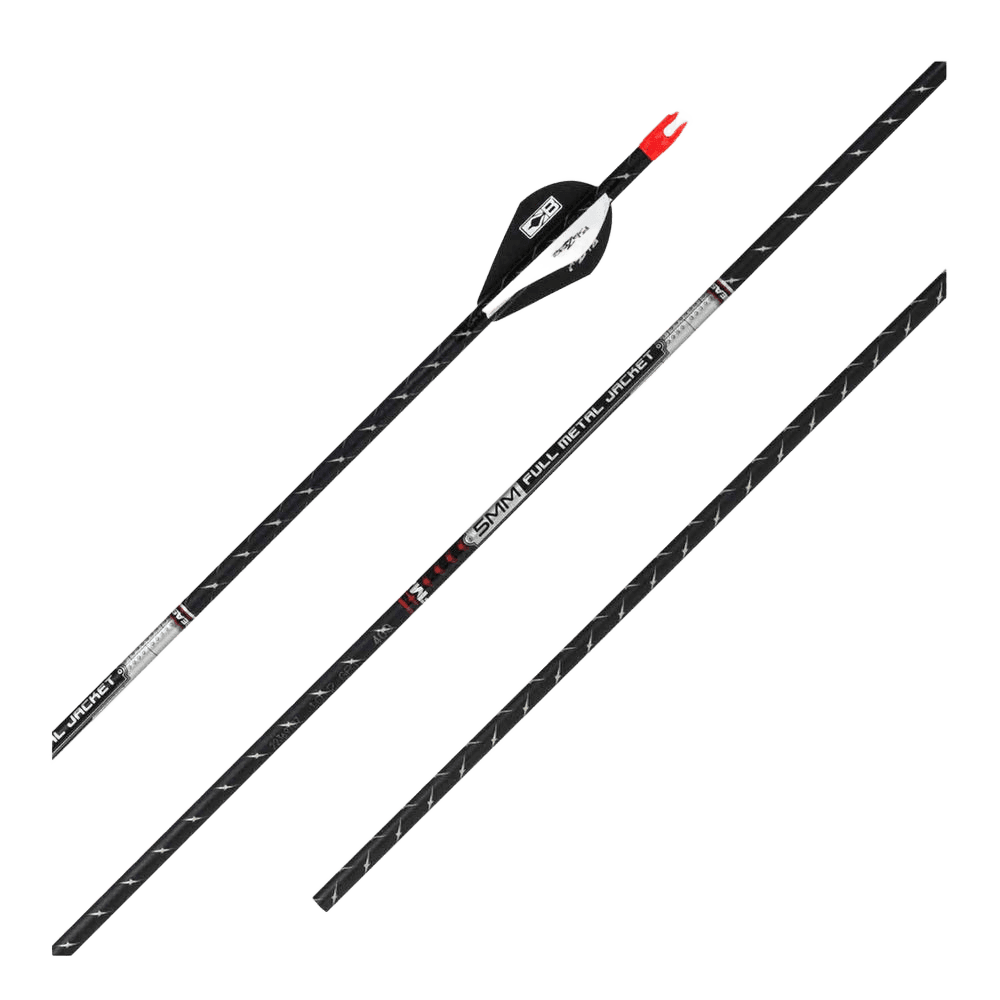
The benchmark weight-forward big-game arrow. A 7075 aluminium jacket over a carbon core adds mass and momentum for deep penetration and effortless pull-out. For hunters who want a heavy, durable, hard-hitting shaft.
Standout feature: Full-metal-jacket construction adds mass and a slick, easy-extraction surface.
The verdict
The Easton 5mm FMJ earns a CareScore of 79.1/100 (excellent), ranking #3 of 8 arrows we’ve scored at $187.99. Full-metal-jacket construction adds mass and a slick, easy-extraction surface.
Scored by the published CareScore v1.1.11 methodology from manufacturer specs, June 2026.
Pros
- Heavy, hard-hitting and deep-penetrating
- Extremely durable jacket
- Easy to pull from targets and game
Cons
- Slower than light all-carbon shafts
- Premium (Match Grade) pricing
Real questions archers ask about the 5mm FMJ
Mined from public archery communities (June 2026); answered by Archery Care using our scored data. Source links go to the original discussions.
Will 5mm FMJs bend or lose straightness with regular practice?
This is the single most contested point in every thread we reviewed. High-volume shooters report dents, micro-bends and wobble developing over a season — especially when grouping arrows into the same spot — while several long-term owners say their shafts have lasted years and that minor bends can sometimes be worked back out with an arrow straightener. A common community compromise is to hunt with FMJs and practice with a cheaper all-carbon shaft.
Should I buy the 5mm FMJ or the 5mm Axis?
The community splits along a consistent line: owners pick the FMJ for maximum mass, momentum and easy target pull-out, and the Axis for durability under heavy practice — with the Axis the more common recommendation for newer shooters who will occasionally miss into something hard. Both are well regarded; the 5mm FMJ scores 79.1/100 on our CareScore and ranks #3 of 8 in our arrows category, with its weight-forward, deep-penetrating build as the standout. If you mainly shoot to confirm a hunting setup rather than for volume, the FMJ's bending risk matters less.
Is the 5mm the right FMJ, or should I go 4mm or 6mm?
Owners who have shot multiple diameters generally call the 5mm the sweet spot: in the threads we reviewed it was reported as less bend-prone than the 6mm and as having better components, and reports on the 4mm are split, with its half-out insert system the most common complaint. The 5mm runs a 0.197-inch diameter and comes in five spine options, and owners note it actually carries more weight per inch than the comparable 6mm spines — part of its appeal as a hunting shaft.
My broadheads overhang the 5mm shaft — do I need an adapter?
No — owners report the slight overhang of a standard-thread broadhead over the 0.197-inch shaft is intentional, and the community says it hunts fine as-is; Easton's BAR (Broadhead Alignment Ring) and the newer HIT collar are available if you want a flush, supported fit. Owners also suggest smaller-diameter field points for practice to save wear on targets, and some add aftermarket impact collars for extra protection at the insert.
Are they worth the roughly $188 asking price?
Our $187.99 figure reflects the ±.001-inch Match Grade variant; the standard 5mm FMJ guarantees ±.002 inches and typically costs a little less. The community is genuinely split on value: long-term owners call it buy-once-cry-once quality, while high-volume shooters argue the bending risk means you may keep paying to replace shafts, and that cheaper carbon options are the smarter spend. We rate it 79.1/100 and #3 of 8 in its category, with premium pricing listed among its trade-offs.
How do 5mm FMJs actually perform on game?
On-game reports in the threads we reviewed are strongly positive: owners describe pass-throughs on deer and blacktail and kills on heavy game up to bison, eland and zebra, crediting the carbon-aluminium shaft's mass and momentum. The trade-off owners acknowledge — and our data agrees — is speed, since a heavy jacketed shaft gives up velocity to light all-carbon arrows. A vocal minority argues you can reach similar total weight with heavier points on a tougher carbon shaft instead.
Community Pulse
What owners and shoppers actually say, quantified across 11 public discussions reviewed in June 2026.
Bending and long-term durability under volume shooting
mixedThe dominant debate across every venue: many owners report dents, micro-bends and wobble developing in the aluminium jacket over time, especially from grouped arrows or hard misses, and several reserve FMJs for hunting while practicing with carbon. A persistent minority of long-term owners pushes back, reporting years of use with few issues and noting bent shafts can sometimes be re-straightened.
Penetration, mass and on-game performance
praiseOwners consistently credit the heavy jacketed shaft with pass-throughs and clean kills, including on very large game, and note heavier arrows also quiet the bow. One dissenting camp argues the jacket's weight distribution hurts front-of-center and that the same total weight is better added at the point.
Easy pull-out from foam and bag targets
praiseA smaller but unanimous point: owners say the metal jacket pulls from foam targets far more easily than all-carbon shafts, and some call it one of the FMJ's biggest practical advantages.
The FMJ-vs-Axis rivalry
mixedWhenever the FMJ comes up, its all-carbon sibling the Axis is the default comparison, and in head-to-head threads the Axis usually wins the vote on durability grounds — with brass inserts suggested to recover the lost weight. FMJ loyalists counter that nothing matches its out-of-box mass, straightness and target extraction.
HIT inserts, collars and broadhead fitment
mixedComponent talk is constant: some owners report Easton's HIT insert system works flawlessly with standard glue-up, while others call it a weak point — citing splitting at the insert or recommending JB Weld and aftermarket impact collars. Broadhead overhang on the slim shaft is by design, with Easton's BAR rings and HIT collars the standard fixes when a flush fit is wanted.
Premium price and replacement cost
criticismOwners repeatedly flag the FMJ as expensive relative to alternatives, and high-volume shooters argue the bend-and-replace cycle compounds the cost. The counterpoint from loyalists is buy-once-cry-once quality, with per-arrow pricing comparisons against the Axis appearing in multiple threads.
How we counted: we read 11 public discussions across archery forums and communities, grouped recurring topics, and counted distinct threads (not comments) where each theme appeared favorably or critically. Summaries are paraphrased in our own words; every count links to its sources. Note: Discussion volume is high on dedicated forums and thin on Reddit. Method and caveats: (1) ArcheryTalk's normal bot gateway (tollbit) returned HTTP 402, so the five ArcheryTalk threads were fetched directly with a standard browser user agent via their numeric thread IDs (e.g. archerytalk.com/threads/6148700/), which resolve to the canonical slugged URLs listed; post text and dates were extracted fr
Video answers
Questions answered in Extreme Outfitters’s video review of the Easton 5mm FMJ, summarized by Archery Care — click any question to jump the video to that exact moment.
“Easton FMJ Arrow Review | 4mm vs 5mm Comparison” · Extreme Outfitters · watch on YouTube
CareScore breakdown
How the 79.1/100 was built. Each spec is normalised to a 0–100 quality score, then weighted.
Data note: Price/specs reflect the ±.001" Match Grade variant; the standard 5mm FMJ guarantees ±.002" and typically costs a little less. A lighter FMJ Max variant trims roughly 1.5 GPI.
Full specifications
| Straightness Tolerance | 0.001" |
|---|---|
| Price / Dozen | $187.99 |
| Shaft Diameter | 0.197" |
| Weight Tolerance | 0.5 gr |
| Spine Options | 5 |
| Material | Carbon-aluminum |
5mm FMJ
Compare the Easton 5mm FMJ
Spec-by-spec, CareScore-driven head-to-heads against every rival in the category.
Where the 5mm FMJ ranks
Get more from your arrow
Save & share this breakdown
The pin-ready spec card for the Easton 5mm FMJ — auto-generated from the same scored data as this page.
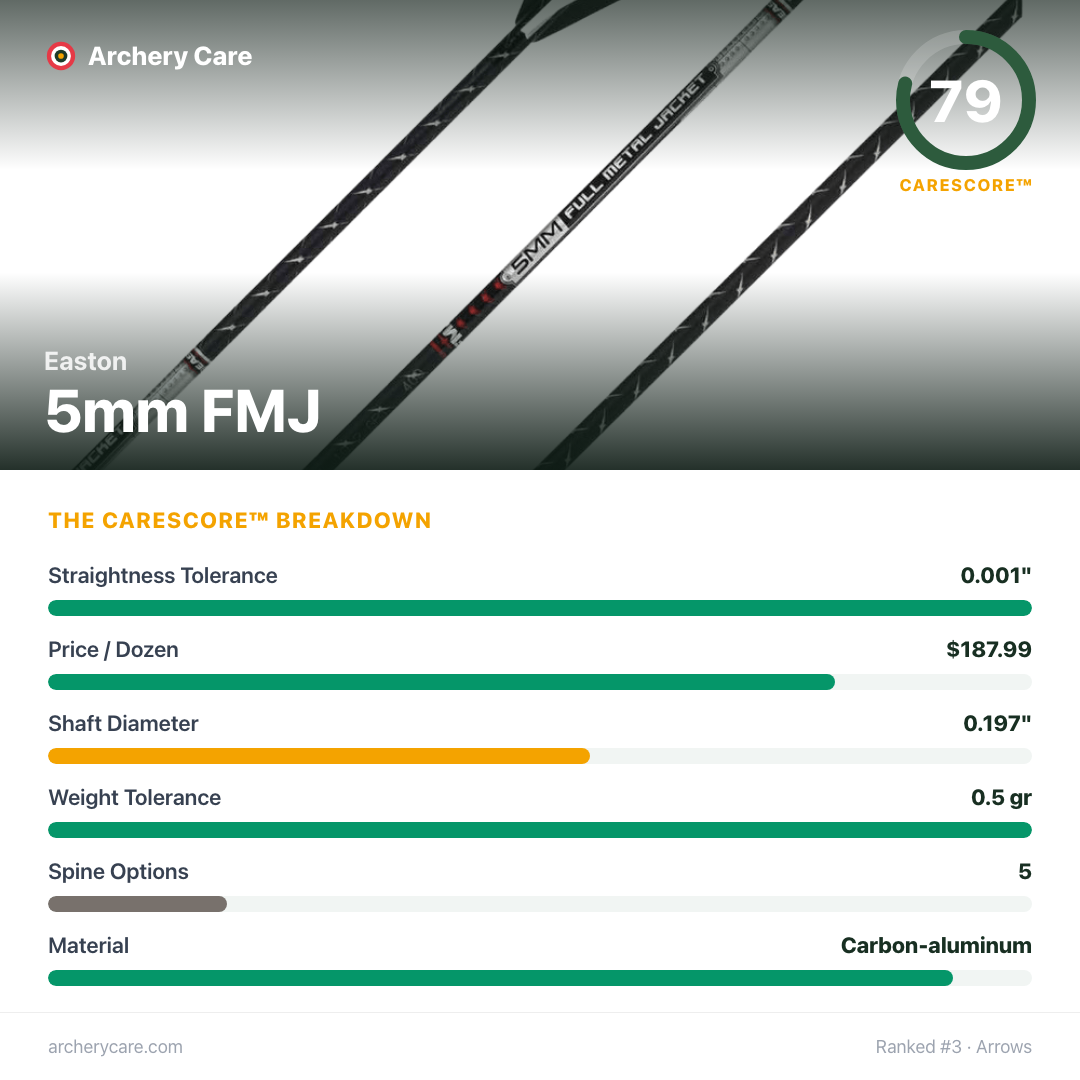
Pin it, post it, or drop it in a group chat — the score, the top specs and the source travel with the image. When this page’s data updates, the card regenerates automatically.