Archery Safety Rules: Range Commands, Gear Checks, Dry Fire
Nearly every archery accident traces to one of three things: someone downrange, a bow fired without an arrow, or gear that was visibly failing before the shot. Here's how to control all three — whistle commands, inspection habits, and the injuries worth preventing.
By the Archery Care Editorial Team
Watch it done
Reputable tutorials that demonstrate this, hand-picked by Archery Care. The walkthroughs are the creators’ own — we just point you to the good ones (and, where they added chapters, straight to the moment that matters).
Almost every archery accident traces back to one of three things: somebody downrange when they shouldn't be, a bow fired without an arrow, or equipment that was visibly failing before anyone drew it. Control those three and you've controlled most of the risk in the sport.
That's genuinely good news. None of the rules below are complicated, and none of them cost money. They just have to become automatic.
Safe archery is boring archery: the same commands, the same two-minute gear check, the same line discipline every single session. The sport rewards repetition anyway. Build the safety into the routine and it stops costing you any thought at all.
Range rules that actually matter
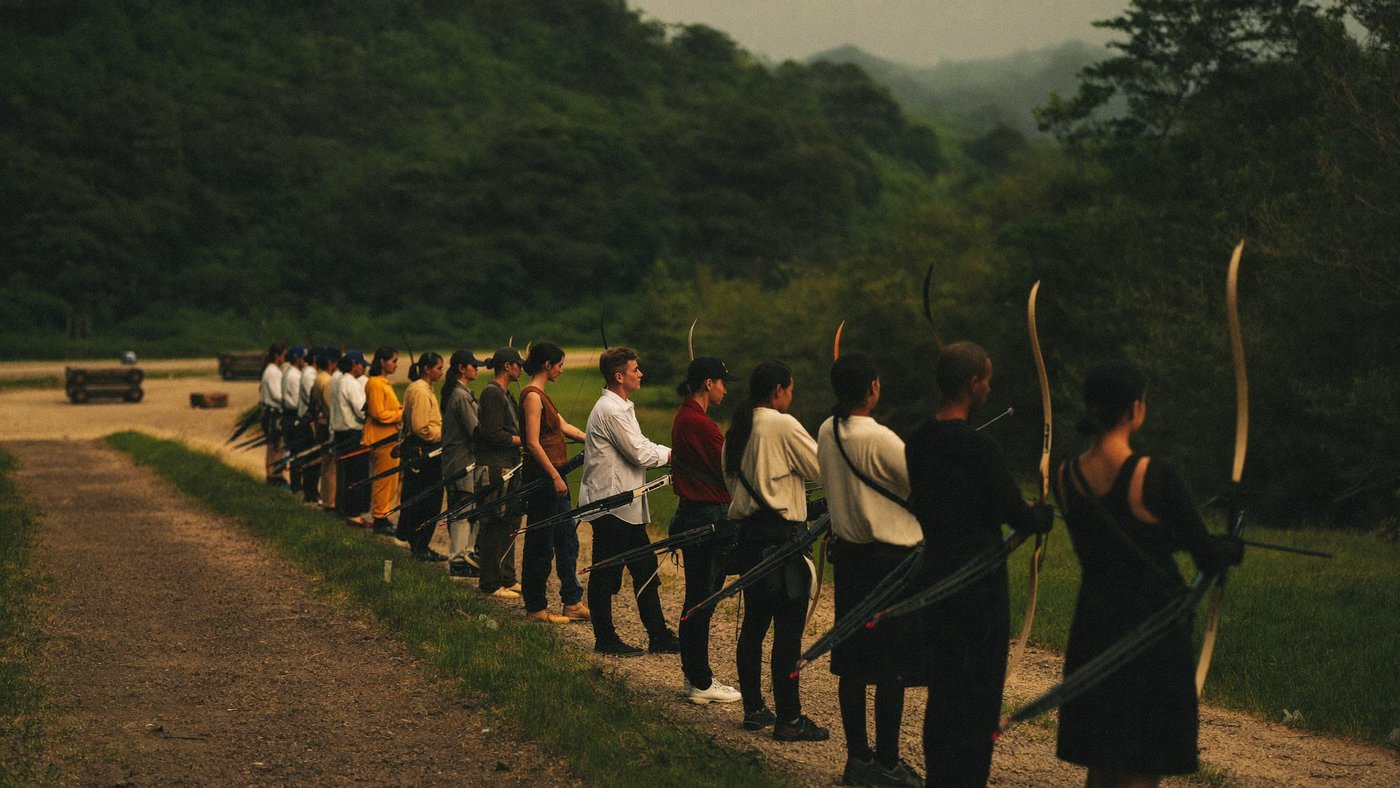
Every club writes its own rulebook, but they're all variations on one idea: nobody touches a bow while anyone is past the shooting line.
- Nock arrows only at the shooting line, only when pointed downrange. Carry arrows point-down everywhere else.
- Never draw a bow without permission to shoot — even with no arrow on the string. Sky-drawing (pulling back with the bow angled upward) gets you ejected from most ranges, because an accidental release sends an arrow over the backstop.
- Wait for everyone on the line to finish before anyone steps forward. The slowest shooter sets the pace. That's the deal.
- Walk to the targets. An arrow buried at ankle height in the grass will find a running archer's shin.
- Approach the target from the side, never head-on. Nock ends sticking out at eye level are exactly as dangerous as they sound.
- Stand beside the target to pull arrows, one palm flat against the face, and check behind you first. An arrow comes out faster than you expect, and the person standing at your elbow catches the nock.
The whistle system
Four signals run an organized range, and they're the same ones used at USA Archery and World Archery events, so learn them once and they work everywhere.
Two blasts: archers to the shooting line. One blast: begin shooting. Three blasts: the end is over — go collect your arrows. Four or more rapid blasts: emergency. Let down immediately, ground your bow, step back.
That last signal overrides everything, and anyone on the range can trigger it — a shouted STOP carries the same authority. If a dog wanders onto the field or someone walks downrange, you call it. Don't wait to see if somebody more senior noticed.
Check your gear before every session
A two-minute inspection catches nearly everything that fails mid-shot.
Limbs first. Run a fingernail or cotton ball along each face and edge — cracks and splinters snag. Look hard at the area near the limb pockets, where stress concentrates. On a recurve, sight down the string to check for limb twist. This applies whether you shoot a Galaxy Sage or a Hoyt Carbon RX-10; carbon is brilliant at hiding damage right up until it isn't.
Strings next. Fuzzy is fine — that's just wax overdue. A cut or broken strand is not fine. Retire the string that day. Same for serving that's separated enough to show the strands underneath.
Arrows get the flex test. Bend each carbon shaft gently and listen; a cracked carbon arrow can shatter on release and put splinters through your bow hand. Run fingers down the shaft for raised fibers, and check nocks for hairline cracks, because a nock that fails at full draw produces a dry fire with your face right behind it.
Arrow length is a safety spec, not a preference
An arrow shorter than your draw can slip behind the rest at full draw — and the bow will then drive that shaft into your hand. It's one of the ugliest injuries in the sport and it's entirely preventable.
The old rule of thumb holds: at least an inch of shaft past the rest at full draw. Measure your actual draw length before cutting anything (a draw length calculator gets you close; a shop measurement nails it), and match spine to your setup, since a badly underspined shaft flexes harder than it should on every shot. An arrow spine calculator sorts that in about a minute.
Dry fire: the one-shot mistake
Release a drawn string with no arrow nocked and every bit of stored energy that should have launched the arrow slams into the bow instead. On a modern compound — the current crop runs 338 to 357 fps IBO — one dry fire can mean warped cam tracks, bent cams or axles, a derailed string, and splintered limbs. Sometimes the bow comes apart entirely, with the string lashing back toward your face.
Recurves survive it more often because they store less energy. More often. Not always.
Crossbows are the worst case — the fast ones now exceed 500 fps, and a Ravin R500 holds all of that energy at full cock for as long as it's loaded. Never pull the trigger without a bolt, and never decock by firing empty; use the crank or a dedicated decocking bolt. Many current models include anti-dry-fire catches. Treat those as a backup, not permission.
Here's the part nobody warns you about: most dry fires aren't done by owners. They're done by a curious friend who asks to feel the draw weight and releases on instinct. Don't let anyone draw your bow unless there's an arrow on the string and a target in front of it.
If it happens anyway, stop shooting. Inspect everything, then take the bow to a pro shop regardless of what you find — dry-fire damage hides, and a limb that looks fine today can let go three weeks from now.
The injuries you'll actually see
String slap tops the list: a bruise or welt along the inner forearm where the string caught you on release. The usual cause is arm position — a hyperextended elbow rotates your forearm directly into the string's path. The fix is rotating your bow arm so the elbow points out and back rather than down. One drill that works: press your palm flat against a wall, arm extended, and rotate the arm until you feel a stretch in your triceps — that's the correct position. Wear an armguard over the exact spot you keep hitting while you retrain. Not roughly there. Exactly there.
Shoulder trouble almost always means overbowing. If you tremble at full draw, or you have to point the bow at the sky to wrestle it back, the draw weight is too heavy — drop it. Pride costs less than physiotherapy. A few minutes of resistance-band pulls before your first arrow helps too; cold rotator cuffs do not enjoy surprises.
Fingers ache the first couple of weeks. That's normal. Raw blisters aren't — they usually mean you're hooking the string too deep. Get a finger tab or glove and place the string in the first joint crease, not the pads.
Real questions archers ask about archery safety
Mined from public archery communities (June 2026); answered by Archery Care using our scored data. Source links go to the original discussions.
Do I really need an armguard, or is string slap just a form problem I should fix instead?
Both things are true at once, and that's the part beginners miss. String slap almost always traces back to form: a locked elbow that hasn't rotated out, gripping the bow in a death-clutch, or a draw length that's too long for you. Fix those and the slapping mostly stops. But here's the honest take from the line: wear the armguard anyway while you're learning. A welt on your forearm makes you flinch, and a flinch wrecks your release, which deepens the bad habit you're trying to break. Treat the guard as training wheels, not a cure. Once your elbow rotation is automatic and you've gone several sessions without contact, you can ditch it.
When is it actually safe to walk down to the target and pull my arrows?
Never go forward of the shooting line until every bow on the line is down and someone has called the range clear. The rule that gets argued about is whether you can stroll down alone when you've finished but others are still shooting. Don't. The moment anyone is at the line with a bow in hand and arrows nocked, the downrange area is hot, full stop. At a club this is whistle-driven; in casual settings you say it out loud: 'Everybody done? Clear to go get 'em?' Then you all walk together. The flip side matters too: nobody nocks an arrow or even picks up a drawn bow while a single person is still downrange pulling.
Can I safely set up an archery range in my backyard?
Maybe, but the bar is higher than people think. First, check your local ordinance and any HOA covenant. Plenty of towns ban discharging a bow within city limits, and most HOA rules written in the last few decades lump archery in with firearms. Second, the safety math: a wood fence is not a backstop. A blown release, a broken D-loop, or a cracked nock can send an arrow high or sideways, and that has happened to experienced shooters. You need a dedicated backstop that stops a full-power miss, generous space behind the target, and a clear line of sight so nobody wanders in. Tell your neighbors before you start. A friendly heads-up prevents a panicked call to the police.
How do I handle and transport broadheads without cutting myself?
Respect them like razor blades, because that's basically what they are. A broadhead sharp enough to kill cleanly will cut you to the bone, and most field cuts happen during careless moments, not draws. Keep heads in a covered quiver, never loose in a pack or pocket, and screw them on by gripping the wrench or a thick rag rather than pinching the blades. Falling onto a quiver of exposed heads is a real injury, especially on rough terrain. If you carry sharp heads in the field, carry the means to deal with a deep cut too: a pressure bandage or clotting gauge weighs nothing and beats trying to improvise a tourniquet with shaking hands miles from the truck.
Is overdrawing my recurve or longbow dangerous, or just bad for accuracy?
It's both, and on a trad bow the safety side is real. Pull past the draw length the bow was built for and you hit stack, where draw weight climbs fast per inch and the limbs get overstressed. Do it repeatedly and you're shortening the limb's life and risking a failure under load, which is exactly when you don't want one. Recurves tolerate a longer draw better than most bows, but 'tolerate' isn't 'designed for.' The fix is to find your true, repeatable draw length and match your arrows to it, with at least an inch of shaft past the front of the riser, more for broadheads, so the point can't reach your bow hand. Chasing extra power by overdrawing trades a little speed for a lot of risk.
Community Pulse
What owners and shoppers actually say, quantified across 6 public discussions reviewed in June 2026.
Range safety is everyone's job, and complacency at casual ranges is the real danger
mixedMost shooters agree the formal whistle-and-line system exists because it works, and they'll speak up when someone walks downrange early or nocks an arrow with people still pulling. The friction shows up at unsupervised public ranges, where there's no range officer and regulars quietly tolerate sloppy habits. A few argue you can't police strangers and should just shoot elsewhere; the majority push back that one careless person endangers the whole line.
String slap should be fixed with form, not just covered by an armguard
mixedThe strong consensus is that string slap is a symptom: locked elbow, bad grip, or too-long draw length. Fix the cause and the welts stop. The split is over the armguard itself. Most say wear it while you learn so pain doesn't build a flinch into your shot, then drop it once form is solid. A minority treat the guard as permanent kit and see no reason to retire it.
Backyard shooting is a legal and liability minefield, not just a setup question
mixedPlenty of archers shoot at home and defend it as fine with a proper backstop and sensible spacing. The louder voices warn that a wood fence won't stop a blown release, that local ordinances and HOA covenants often ban it outright, and that one stray arrow into a neighbor's yard ends the conversation. The shared advice across both camps: check the law, build a real backstop, and tell the neighbors before you ever nock an arrow.
How we counted: we read 6 public discussions across archery forums and communities, grouped recurring topics, and counted distinct threads (not comments) where each theme appeared favorably or critically. Summaries are paraphrased in our own words; every count links to its sources. Note: Discussion concentrates on ArcheryTalk, where dry-fire panic threads and line-etiquette debates run deepest; Rokslide owns the broadhead-handling angle and TradTalk owns overdraw safety.