How to String a Compound Bow (Why You Need a Press)
Compound bows can't be strung like a recurve — the cams and cables hold the limbs under preload. What a bow press does, when a portable press works, and the one older-bow exception.
By the Archery Care Editorial Team
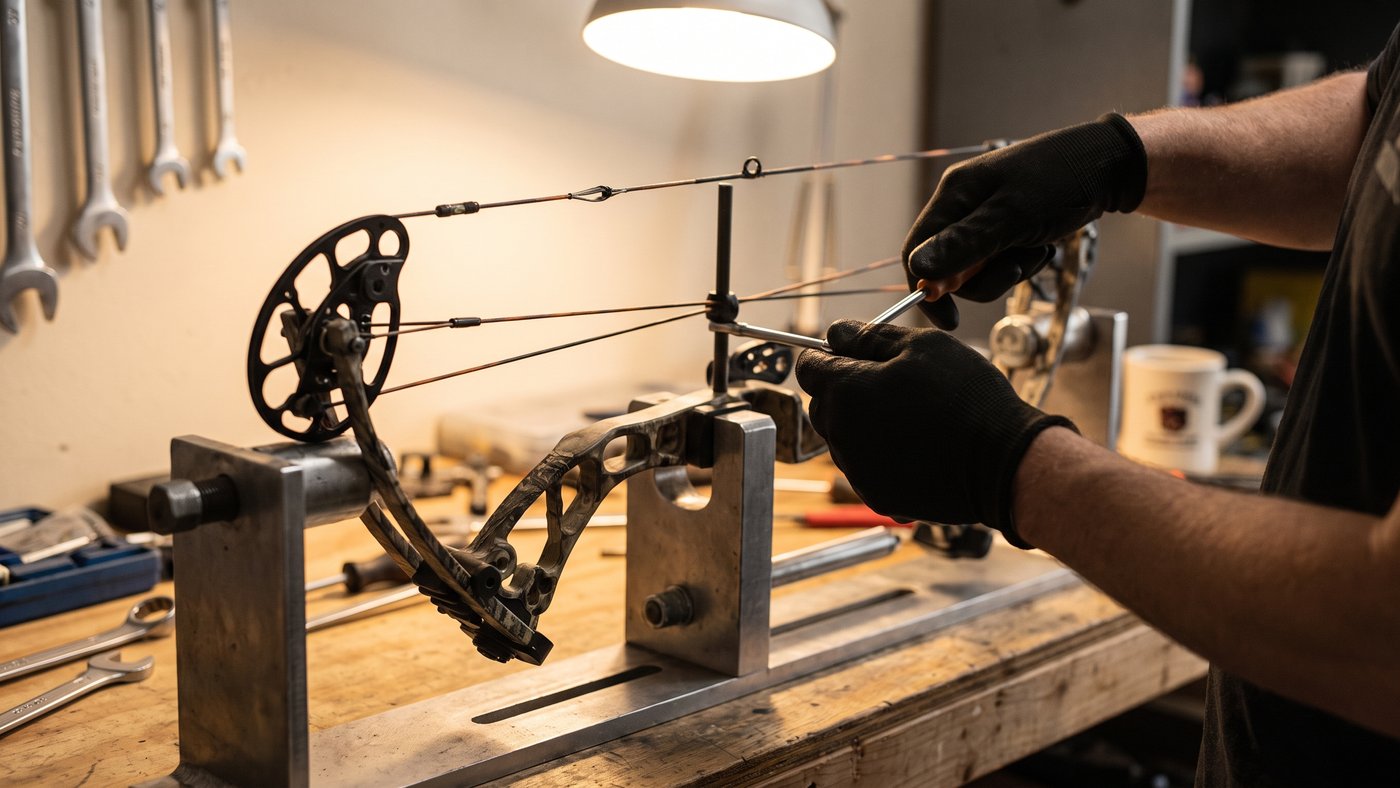
Search 'how to string a recurve' and you get a stretcher and thirty seconds of technique. A compound is a different machine: the limbs are under heavy preload even at rest, and the string and cables route through cams that hold the whole system in tension. Stringing one means safely removing that tension first — and that's a bow press's job.
So the honest answer to 'how do I string a compound bow' is: with a press, or at a shop that has one. Here's the full picture, including the exceptions.
Why you can't muscle it like a recurve
A recurve stores energy only when you draw it; at rest, the limbs are nearly relaxed, which is why a step-through or a stringer works. A compound's limbs are pre-stressed at brace — that's where the let-off geometry comes from — so there's no slack state to work with. The string, cables, cams and limbs are one loaded system.
Trying to force it — step-through methods, loosening random bolts, prying at cams — is how risers get cracked, cams get bent, and hands get hurt. A failing compound releases a lot of stored energy at once. Don't be the video.
Option 1 — The pro shop (the right answer for most people)
A shop with a press will swap your string and cables, set the brace height and axle-to-axle to factory spec, time the cams, and usually install your peep while they're in there. It's fast, it's inexpensive relative to any mistake, and you walk out with a bow that's back in tune — not just restrung.
If you shoot a new custom set (our bowstrings category scores the makers), having the shop install it is the standard move: custom strings need a stretch-and-settle cycle, and shops re-check timing after it.
Option 2 — Your own press
If you want to do your own work, a press is the entry fee. Two kinds:
- Bench presses compress the limbs evenly from both ends — safe for essentially every modern bow, including past-parallel limb designs, and the right tool if you'll do regular string work.
- Portable cable-style presses are fine for field fixes on many bows, but past-parallel and some carbon-limb designs are NOT compatible with certain portables — check your bow maker's approved-press list before squeezing anything.
With the bow pressed, the actual swap is methodical: photograph the cam routing first, replace ONE cable or string at a time so the routing is never ambiguous, transfer the settings (brace height, axle-to-axle, cam timing marks), then let the press out slowly and re-measure everything. If those sentences read like a foreign language, that's your sign to use Option 1.
The exception: old teardrop-style compounds
Compounds from the 1970s and 80s — think early Bear Whitetail-era bows — often used steel cables with teardrop fittings on the ends, with two slots so a new string can be looped on next to the old one. On those bows you can genuinely change a string without a press: draw the bow slightly in a safe, controlled way (some owners use the original method of a wall-mounted drawing fixture), hook the new string in the second slot, let down, and remove the old one.
If you've inherited one of these, have it inspected before shooting it at all — forty-year-old limbs and cables have their own opinions about being drawn.
When to replace, not just restring
Strings tell you when they're done: fuzzing you can't wax away, broken strands, serving separating at the cam, or a peep that keeps rotating no matter how you set it. Age counts too — two to three seasons of regular shooting is a normal lifespan, less if the bow lives in a hot truck.
And if the string's tired, the cables are the same age. Replace them as a set — mixed old-and-new sets never quite tune, which is why every maker sells complete string-and-cable packages.