Recurve Bow Brace Height Chart (and How to Tune Yours)
The standard brace height ranges for every recurve length from 58 to 72 inches, how to measure yours, and how to tune inside the window by twisting the string.
By the Archery Care Editorial Team
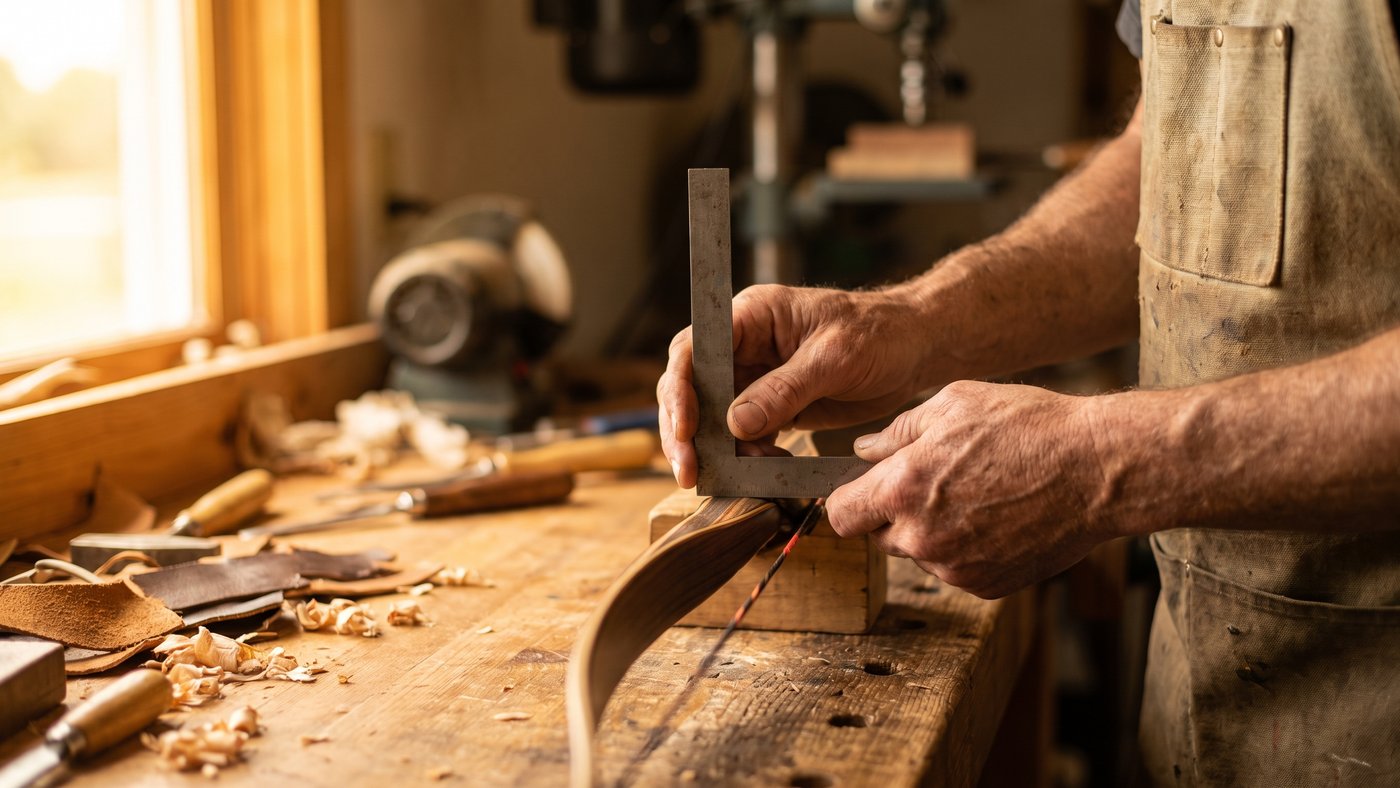
Brace height is the distance from the deepest part of your grip to the string when the bow is strung and at rest. It's the first thing to check when a recurve gets loud, slaps your forearm, or starts throwing arrows it used to group — and the fix usually costs nothing but string twists.
Here's the chart, then how to use it.
The brace height chart
Find your bow's AMO length — it's printed on the lower limb of almost every recurve. These are the consensus starting windows:
Bow length (AMO) Brace height range 58" 7½" – 8¼" 60" 7¾" – 8¼" 62" 7¾" – 8½" 64" 8" – 8½" 66" 8¼" – 8¾" 68" 8½" – 9" 70" 8¾" – 9¼" 72" 9" – 9½" Consensus starting ranges for modern recurves. If your bow came with a manufacturer's card or manual, that window wins — some designs run deliberately outside these numbers. One-piece traditional recurves and longbows sit lower: most longbows brace happily somewhere between 6¾ and 7¾ inches. And Olympic risers with adjustable limb pockets can shift the whole window, which is why the manufacturer's card beats any generic chart.
How to measure it
Use a T-square — the clip end hooks on the string, the ruler leg rests in the grip. Read the distance from the string to the throat of the grip, which is the deepest point where the web of your hand sits, not the arrow shelf and not the back of the riser.
No T-square? A ruler works if you're careful to measure from the throat, square to the string. But a T-square costs less than a dozen arrows and you'll use it every time you set up a string, so just buy one.
How to change it
Twist the string. That's the whole tool.
- Brace height too LOW → unstring the bow, add twists (a shorter string sits further from the riser), restring, re-measure.
- Brace height too HIGH → remove twists.
- Expect roughly 5–10 twists to move it about ¼ inch, though it varies with string material and length.
- Keep total twists moderate — a string that needs 60 twists to reach brace is the wrong length. Get the right string instead.
If you run out of twist range in either direction, the string is the problem, not the bow — check our string length guide for what you should actually be shooting.
Tuning inside the window: what you're listening for
The chart gives you a range, not a number, because the right brace height is the one where YOUR bow goes quiet. Lower brace heights are marginally faster — the string pushes the arrow longer — but harsher and louder. Higher is more forgiving and quieter, at the cost of a little speed.
The method: start at the bottom of the window. Shoot three arrows. Add three or four twists, shoot again. Somewhere in the range the bow will audibly settle — less twang, less hand buzz, arrows grouping. That's your number. Write it down, and check it now and then, because strings creep and settle over their first hundred shots.
Symptoms of a wrong brace height
- String slapping your forearm or wrist — classic low brace height (though poor grip rotation does it too).
- Loud, twangy shot with buzz in the riser — usually low; add twists.
- Bow feels dead and sluggish, arrows drop — often braced too high; you're wasting stroke.
- Erratic arrow flight that cleans up when you re-brace — the string had untwisted itself over time, which is normal. Re-set it.
Quick answers
Does brace height change draw weight? Marginally — braceing higher effectively shortens the power stroke, and you lose a touch of stored energy. It won't rescue a bow that's too heavy for you.
Same chart for takedown and one-piece? Modern takedowns, yes. Vintage or heavily traditional one-piece bows often like the lower end, and some old designs sit under these windows entirely — defer to the maker.
How often should I check? Every time you string the bow with a new string, then occasionally after. New strings stretch; a settled string mostly holds.