Recurve Bow String Length: The 4-Inch Rule (with Chart)
String length isn't bow length — it's shorter by a rule. The AMO standard explained, a length chart for every bow size, and how to measure a string you already own.
By the Archery Care Editorial Team
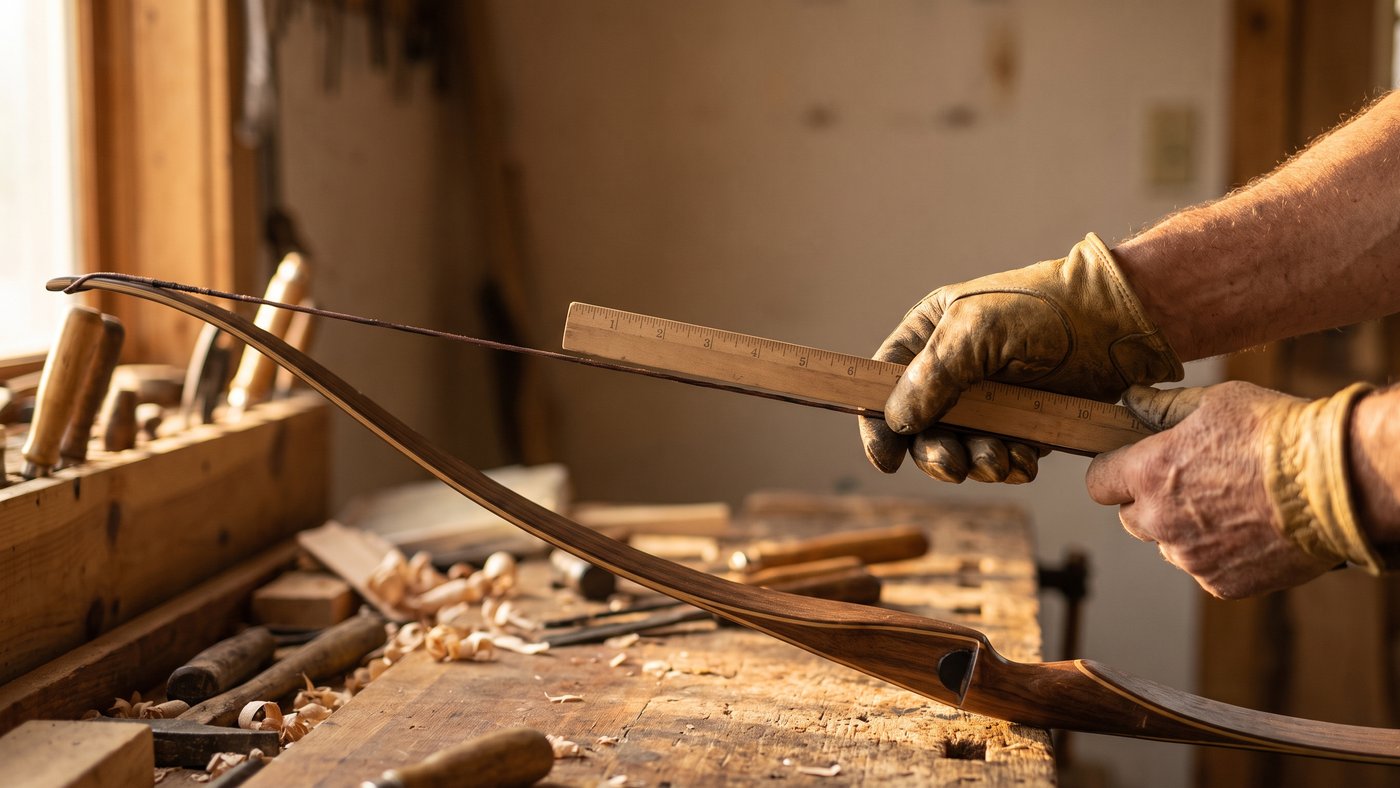
Buy a 68-inch string for a 68-inch recurve and it'll flop around like a jump rope. Nobody tells you this at checkout. String length and bow length are two different measurements, and the gap between them is the whole trick.
The rule
Recurve: take the AMO bow length and subtract 3½ to 4 inches. Longbow: subtract 3. Done — that's the rule.
Here's the wrinkle that causes most ordering mistakes. A string sold as 'AMO 66' isn't 66 inches long — the maker already did the subtraction, so it's a roughly 62½-inch string FOR a 66-inch bow. Some listings quote actual length, some quote AMO designation, and they differ by four inches. Read the listing twice. When in doubt, email the seller; string makers answer this question fifty times a week.
String length chart
Bow length (AMO) Recurve string (actual) Longbow string (actual) 48" 44" – 44½" 45" 54" 50" – 50½" 51" 58" 54" – 54½" 55" 60" 56" – 56½" 57" 62" 58" – 58½" 59" 64" 60" – 60½" 61" 66" 62" – 62½" 63" 68" 64" – 64½" 65" 70" 66" – 66½" 67" Actual string lengths by the subtract-3½-to-4 rule (recurve) and subtract-3 rule (longbow). Verify against your brace height after installing. How to measure a string you already have
Hook both end loops over something solid. Two nails in a beam, the pegs of a bow square, door handles in a pinch. Pull it taut — a limp string on the carpet measures short every time — and read outside-of-loop to outside-of-loop.
Got a string on the bow that shoots well? Skip the tape measure. Write down the brace height and count the twists before you pull it off, order the same length, and you can rebuild the exact setup. Lazy, and correct.
Why twists mean length isn't gospel
A string isn't a fixed length — it's adjustable, and twisting is the adjuster. More twists, shorter string, higher brace height. Fewer twists, the opposite. The chart lands you in the neighborhood; the twist count walks you to the door.
One sanity check: a right-sized string braces your bow with maybe 10 to 25 twists in it. Zero twists means the string's too short. Sixty means it's too long, and a heavily-twisted string shoots mushy besides. Either way, change lengths by half an inch and start over.
Material footnote
Dacron (B-50/B-55) stretches, and that's the point — older bows, wooden risers, and anything without reinforced limb tips need that give, or the tips eat the shock instead. Fast-flight blends like BCY's 452X barely stretch at all. Wonderful on modern limbs rated for them; a limb-tip cracker on granddad's Kodiak. Same length rule either way — the fast-flight just settles inside a few dozen shots and then stays put, where Dacron keeps creeping for weeks.