How to Aim a Recurve Bow: Sights, Gaps, and String Walking
There are four ways to aim a recurve: a sight, gap shooting off the arrow tip, string walking, or instinctive shooting. Whichever you pick, a repeatable anchor point matters more than the method itself.
By the Archery Care Editorial Team
Watch it done
Reputable tutorials that demonstrate this, hand-picked by Archery Care. The walkthroughs are the creators’ own — we just point you to the good ones (and, where they added chapters, straight to the moment that matters).
There are four ways to aim a recurve bow: through a mounted sight, off the tip of your arrow (gap shooting), by sliding your fingers down the string (string walking), or by feel alone (instinctive). Which one you use depends mostly on what's bolted to your riser and which class you shoot in.
But here's what nobody tells beginners: the method matters less than your anchor. An archer with a sloppy anchor and a $300 sight will lose to an archer with a locked-in anchor and bare fingers. Every time.
So pick a method, then obsess over consistency.
Start with whichever method your club or class requires, log your marks in a notebook, and give it three sessions before you judge it. Aiming is a memory problem dressed up as a skill problem — feed it consistent data and it sorts itself out.
Aiming with a sight
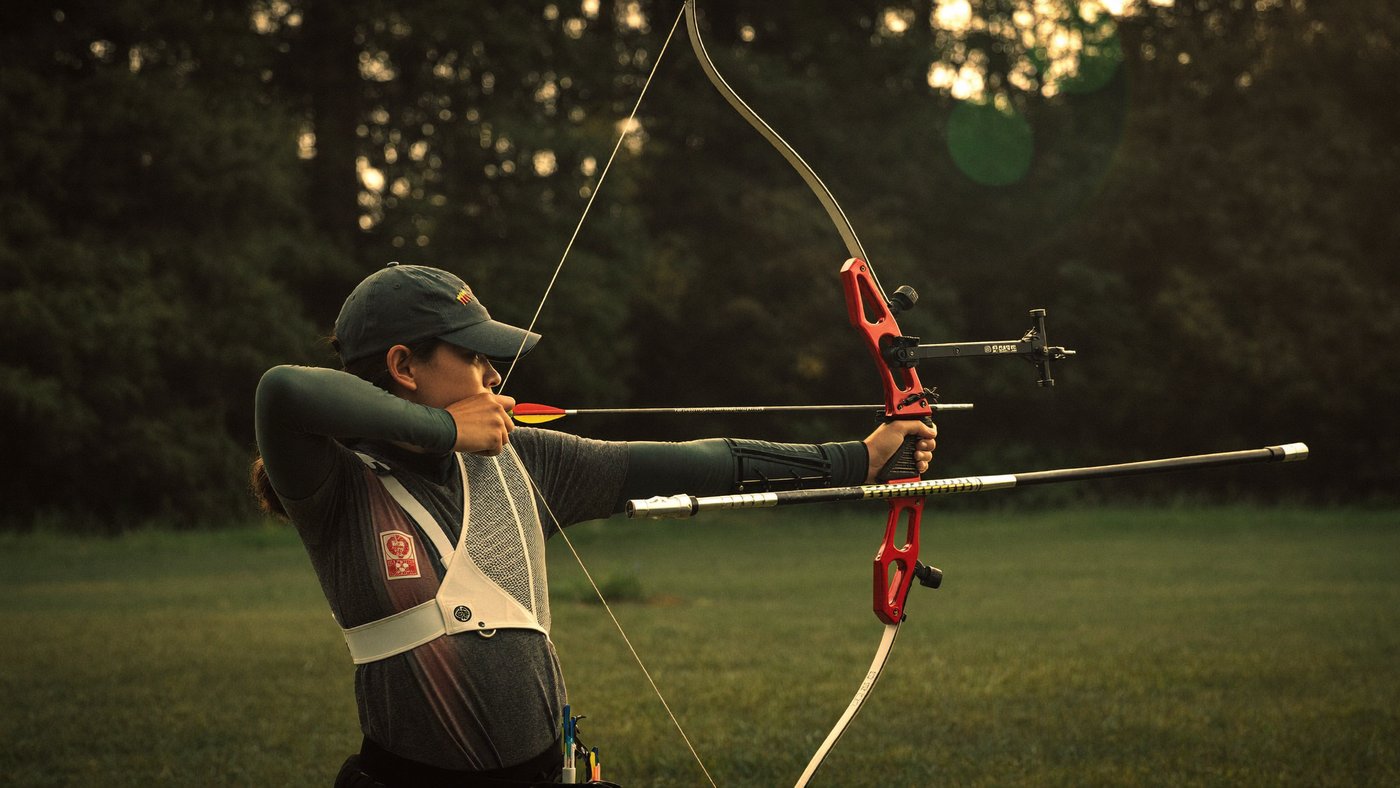
A sight turns aiming into the simple part of the shot. You put the pin on the gold, and if your form repeats, the arrow follows. This is how Olympic recurve works, and it's the fastest route to tight groups for most people.
Keep both eyes open. Focus on the target, not the pin — the pin should sit blurry in your peripheral vision while the gold stays sharp. If you stare at the pin instead, you'll start chasing it around the target face, your draw arm tenses up, and the shot falls apart. Coaches at the Online Archery Academy put it bluntly: the more you force the pin still, the harder it gets. Let it float. Your subconscious centers the wobble better than your conscious mind ever will.
Two details make sighted aiming repeatable. First, the string picture: the blurry vertical line of the string should cross the same spot relative to your sight ring on every shot, or your arrows drift left and right for no visible reason. Second, the under-chin anchor — string touching the center of your chin and the tip of your nose. Three contact points, same draw length, every arrow.
Some archers also pre-aim: setting the pin at roughly 2 o'clock on the red ring during setup, then letting it settle down into the gold as they draw to anchor. Worth trying if your pin tends to dive below center.
Gap shooting
Gap shooting uses the point of your arrow as the sight. At close range the arrow flies above where the tip points, so you aim low. Somewhere out around mid-distance you hit your point-on — the range where aiming the tip dead center puts the arrow dead center. Past that, you aim high.
Your job is to learn the gaps. Shoot at 10 meters, note how far below the gold your tip sat when you hit center. Repeat at 15, 20, 30. Write it down. Archery GB suggests using ground references too — the center leg of the target stand makes a usable aiming point when your gap drops below the boss.
One catch: your gaps belong to your exact setup. Change arrow length, point weight, or spine and the whole chart shifts. This is one place where getting spine right pays off twice — a properly spined arrow (run your numbers through an arrow spine calculator if you're unsure) flies cleaner and keeps your gaps honest.
String walking
String walkers cheat the geometry instead. You always aim the arrow tip at the center — same sight picture every shot — and adjust for distance by moving your tab down the string, away from the nock. That offset is called the crawl. Closer target, bigger crawl. Longer target, smaller crawl, until you reach point-on, typically somewhere between 30 and 45 meters depending on your draw weight and anchor height.
Competitive barebow archers measure crawls with the stitching on their tab. Bow International's working rule of thumb on a stitched tab: two threads of crawl moves your group about one full color ring on the target face. Count threads, log distances, and you've built yourself a sight that's legal in barebow competition.
Fair warning — crawling changes how the limbs load, so serious string walkers end up adjusting tiller slightly negative. Don't worry about that in your first season. Do worry about your anchor: most string walkers settle in directly under the cheekbone, which raises the rear of the arrow and suits the technique.
This is also why dedicated barebow risers like the Hoyt Xceed exist — extra mass low in the riser to stabilize the bow without the stabilizers barebow rules prohibit. A budget takedown like the Samick Sage will string walk fine while you learn, though.
Instinctive shooting
Instinctive aiming sounds romantic. No reference points, no charts — you look at the spot, draw, and your brain solves the trajectory the way it solves throwing a ball.
It works. It's also the slowest method to learn by a wide margin. You're building distance-feel through thousands of repetitions at varied ranges, and most archers find their groups stay loose for months before the pattern clicks. If your goal is hunting at unknown distances or pure traditional shooting, it's worth the investment. If your goal is scoring rounds at marked distances, gap shooting gets you there far sooner.
Anchor consistency is the whole game
Every method above assumes one thing: identical draw length, shot after shot. Archery GB's barebow coaching makes the stakes plain — without a clicker, even a centimeter of variation in draw length is enough to destroy your grouping. A centimeter. That's the difference between your knuckle pressed into your cheekbone and floating just off it.
Pick an anchor with hard contact points. Under-chin with string-on-nose for sighted shooting. Index finger in the corner of the mouth for beginners and many gap shooters. Under the cheekbone for string walkers. Then drill it on a blank boss at 5 meters until you stop thinking about it.
Knowing your actual draw length helps here too — it determines arrow length and what gaps you'll see. A draw length calculator gets you a starting number; your anchor makes it repeatable.
Faults that wreck your aim
Most missed shots aren't aiming errors at all. Check these first:
- Freezing on the gold — forcing the pin or tip to hold still builds tension and triggers a snatchy release. Let it float and commit.
- Anchor drift — your hand creeps higher on your face as you fatigue, and arrows climb with it. End the session before your form does.
- Inconsistent string picture — string blur wandering left or right of your reference means lateral misses you'll wrongly blame on wind.
- Peeking — dropping your bow arm at release to watch the arrow. Hold your follow-through until the arrow lands.
- Wrong eye doing the work — if you're right-handed but left-eye dominant, close the left eye or shoot left-handed. Cross-dominance quietly ruins more beginners than bad equipment ever has.
- Draw length wobble — short-drawing under pressure changes your arrow speed and every gap or crawl you've memorized.
Real questions archers ask about aiming a recurve bow
Mined from public archery communities (June 2026); answered by Archery Care using our scored data. Source links go to the original discussions.
How do I find my point-on distance, and why does it matter for gapping?
Your point-on is the one distance where you can put the arrow tip dead on the spot and hit it, with zero gap. Everything closer needs the tip held low; everything farther needs it held high. To find it, aim point-on at the target and shoot from progressively longer ranges, measuring where the group lands relative to where you aimed, until the arrows actually land on your aim point. That yardage is your anchor for every other gap. It shifts with your setup: a heavier, slower arrow brings point-on closer (say 20 yards), a light fast one pushes it out to 40-plus. Lock your draw, anchor and arrows first, because changing any of them moves the whole gap chart.
I'm cross-dominant (right-handed, left eye dominant). How should I aim a recurve?
You've got three honest options, and forum regulars lean hard toward the first two. Easiest long-term fix: switch and shoot left-handed so your dominant left eye sits over the arrow. If you're already committed to a right-handed bow, close or occlude the left eye so the right eye does the aiming, otherwise the arrow flies toward wherever the dominant eye is looking. An eye patch or a strip of frosted tape on the left lens lets both eyes gather light while forcing the right to aim, which feels less jarring than a full squint. Shooting fully cross-dominant with both eyes open is possible but you'll fight a double image and cap your accuracy.
My recurve sight won't reach the longer distances. What am I doing wrong?
Usually two things. First, run your sight extension all the way out toward the target before you start: way out, one click moves the arrow maybe an inch, so you get fine adjustment and far more usable travel. To gain reach at long range you actually pull the extension back in toward the riser, which steepens the angle and lets the aperture cover more yardage. Second, check your block mounting holes. If the block sits too high, the scope bottoms out on the bar before you reach 20 yards; too low and you run out of room going long. Split-finger anchor also gives you more range than three-under for the same setup, which is why most people shooting 70m sit split.
How do I judge yardage at a 3D or field shoot when nothing is marked?
Don't trust one read. The trick most people land on is cross-checking two or three estimates and splitting the difference. Pick a yardage you've drilled until you can't get it wrong, say a rock-solid 20, then count out from there to the target. Cross-check by judging the halfway point and doubling it, and by chopping the lane into 20-yard chunks. Then translate that number into your gap or crawl. The only thing that builds this is reps off the range: carry a rangefinder, guess distances to fence posts, trees and cars all day, then verify. Light, terrain and uphill or downhill all lie to your eye, so calibrate in the woods, not just the open field.
Do I have to look at the arrow tip when I gap, or can I keep my eye on the target?
Keep your hard focus on the spot you want to hit. The gap and the arrow tip live in your secondary, peripheral vision, not your sharp focus. This is the split-vision idea: you're locked onto the target while you're subconsciously aware of where the tip and the shaft sit below it. If you flick your sharp focus down to the point, you lose the target and your groups open up. A useful in-between is to be aware of the whole arrow, not just the tip, so the shaft acts as a line pointing at the gap. With practice the gap stops being a measured guess and starts feeling like a picture you just recognise.
Community Pulse
What owners and shoppers actually say, quantified across 6 public discussions reviewed in June 2026.
At known distances, gap and string walking beat instinctive shooting
mixedThe common verdict is that any conscious aiming method wins at marked distances because you get instant feedback: low means add gap, high means take some away, so you correct in one shot. Instinctive can take thousands of arrows to reach the same place. The pushback is that at truly unknown distances every method leans on instinct anyway, and a seasoned instinctive shooter who lives in the unknown can be deadly.
Barebow shooters should string walk rather than gap
mixedString walking gets praised for letting you keep the tip on or near the gold across a wide range with one tune, just by changing your crawl, which is why it dominates target barebow. Detractors point out the catch: it forces bare-shaft and tuning compromises, gets awkward under about 10 yards where the arrow climbs into your sightline, and runs out of crawl past roughly 60-65 yards, where people fall back to gapping or face walking anyway.
Aim with both eyes open whenever you can
mixedBoth-eyes-open gets the nod for more light, better depth perception and the range estimation you need outdoors. The honest counterweight is eye dominance: if your dominant eye isn't over the arrow you'll throw shots toward it, and cross-dominant shooters see a confusing double image. The practical middle ground people settle on is occluding or lightly taping the off eye so both gather light while the aiming eye stays in charge.
How we counted: we read 6 public discussions across archery forums and communities, grouped recurring topics, and counted distinct threads (not comments) where each theme appeared favorably or critically. Summaries are paraphrased in our own words; every count links to its sources. Note: Discussion concentrates on ArcheryTalk (sight setup, eye dominance, gap mechanics) and TradTalk (string walking, point-on, barebow method choice); the liveliest debates are gap-vs-instinctive and whether barebow shooters should string walk or gap.