Bear Adapt 2 RTH (The Hunting Public)
Fair
Ranked #6 of 7 budget compound bows
$599.99
The Hunting Public collab, round two. This is the bow you buy after you've outgrown a Cruzer: single cam, 320 fps, 80% let-off, KillerWave dampeners, and a Picatinny sight mount you won't find on anything else at this price. It gives up the mega-adjustability on purpose — 24-31 inches and two limb options — and shoots better for it.
Standout feature: The best-shooting bow in the budget class — a deliberate step-up rig, not a do-everything compromise.
The verdict
The Bear Adapt 2 RTH (The Hunting Public) earns a CareScore of 34.4/100 (fair), ranking #6 of 7 budget compound bows we’ve scored at $599.99. The best-shooting bow in the budget class — a deliberate step-up rig, not a do-everything compromise.
Scored by the published CareScore v1.1.11 methodology from manufacturer specs, June 2026.
Pros
- 320 fps with a forgiving single cam and real 80% let-off
- Picatinny-mounted 4-pin sight and IMS V-Biscuit are a cut above typical RTH kit
- KillerWave dampeners keep it quiet for a budget rig
- Designed with The Hunting Public crew — spec choices feel hunter-driven, not marketing-driven
Cons
- Not a youth or beginner bow: 45 lb minimum and 24 in draw floor
- $600 street is the top of the budget band
- Bear doesn't publish the mass weight anywhere we could find
- Only two limb-weight options (45-60, 55-70) — pick right the first time
Real questions archers ask about the Adapt 2 RTH (The Hunting Public)
Mined from public archery communities (June 2026); answered by Archery Care using our scored data. Source links go to the original discussions.
Is the Bear Adapt 2 a good choice for someone new to bowhunting buying their first bow?
Yes, with realistic expectations — owners and a dealer call it a great bang-for-buck rig with an easy, compact single-cam draw you can shoot all day, and it shares its riser with the pricier Alaskan XT, so it's a capable platform, not just a starter. The catches for a first-timer: at 45 lb minimum / 24" draw floor it's not a youth bow, $600 is the top of the budget band, and you'll want to replace the factory peep and rest. For a new adult hunter who wants a bow that punches above entry-level, it's a strong pick.
Does the Adapt 2 actually perform in the real world, or is the praise mostly YouTube hype from sponsored reviewers?
The praise is mostly real, but temper the speed claims — owners consistently call it smooth, quiet and dead-in-hand for the money, which holds up beyond the sponsored videos. Where the YouTube hype overstates it is speed: it's a forgiving single cam that chronographs well under its 320 IBO claim. So trust the 'shoots nice for the price' reviews; discount the 'fast' ones. It's a pleasant, quiet shooter first, not a speed bow.
Why is my Adapt 2 chronographing so far below the advertised 320 fps, and is that normal?
That's normal for this bow — the single-cam Adapt 2 is widely reported well under its 320 IBO claim, with real-world figures in the 240s-290s depending on draw length, arrow weight and let-off. IBO numbers come from a max-spec lab setup you'll never replicate. If your number is in that range for your setup, nothing's wrong. You can claw back a little speed (next answer), but don't expect to hit 320.
Can I recover some lost speed by swapping the heavy tube peep, going to a drop-away rest, and adding speed nocks?
Yes, those changes recover some speed — swapping the heavy tube peep for a lighter one, going to a drop-away rest, and adding speed nocks all trim weight off the string or reduce drag, and owners do exactly this. Don't expect a dramatic jump; you're recovering a handful of fps, not closing the gap to a flagship. The peep and rest swaps also fix the weak factory parts, so they're worth doing regardless of speed.
Is it worth putting a $200-300 aftermarket rest on an Adapt 2, and which mount do I need for the IMS rail?
It can be worth it because the Adapt 2 is a better platform than typical entry bows — it shares its riser with the Alaskan XT and is The Hunting Public-spec'd, with a Picatinny rail and IMS rest mount built in. For the IMS rail you want an Integrate-mount rest (the same dovetail QAD's MX2 and others use), not a Berger-hole rest. A $200-300 rest isn't crazy on this bow if you're keeping it a while; if it's a short-term starter, a mid-priced rest makes more sense.
Adapt 2 (single cam, smoother) or Bear Alaskan (faster) for the money, and is it worth the online discount if it means paying a shop to tune it?
The Adapt 2 (single cam, smoother) versus the Bear Alaskan (faster) comes down to whether you value an easy draw or speed — owners pick the Adapt 2 for the forgiving, all-day draw cycle and the Alaskan when they want more velocity. On the online-discount question: buying cheap online and paying a shop to tune it is usually still cheaper than a pro-shop package and gets you a properly tuned bow, so it's worth it as long as you factor the tune cost in. Either bow is a sound buy at budget money.
How far can I safely back the limb bolts out to lower draw weight, and what does that do to ATA, brace height and draw length?
Most compound limb bolts back out a few turns (commonly up to ~10 lb below peak) — check Bear's spec for the Adapt 2's exact range and don't exceed it, since bottoming out the limbs is what you avoid. Backing the bolts out lowers draw weight and very slightly increases brace height and ATA while nudging draw length a hair; the effects are small but real, so re-check draw length and re-tune after a big weight change. Stay within the bolt range Bear lists and you're safe.
How does the newer Adapt 2 HP (dual/hybrid cam) compare to the original single-cam Adapt 2 on speed, draw cycle and noise?
The Adapt 2 HP runs a dual/hybrid cam versus the original's single cam, so the HP is faster with a slightly more aggressive draw cycle, while the original single-cam Adapt 2 is smoother and a touch quieter. If you want more speed and don't mind a firmer draw, the HP; if you want the easiest, quietest draw and don't care about the extra fps, the original single cam. Both share the same well-regarded riser and budget-plus build.
Community Pulse
What owners and shoppers actually say, quantified across 8 public discussions reviewed in June 2026.
Strong value for the money and a smooth single-cam draw
praiseAcross multiple threads owners and a dealer call it a great bang-for-buck rig with an easy, compact draw cycle you can shoot all day without fatigue. Several frame it as a serviceable bow that frees up budget for hunting trips rather than gear.
It is slow and falls short of its advertised speed
criticismThe single-cam Adapt 2 is widely described as no speed demon, with multiple owners posting chronograph numbers well under the 320 IBO claim (figures in the 240s-290s depending on setup) and some saying Bear is overstating its numbers. Most accept this as the trade-off for a smooth single cam.
Factory peep, rest and strings are the weak links
criticismA recurring gripe is that the bundled tube/heavy peep is poor (knots reportedly slipped within a week for one owner) and the included Whisker Biscuit rest is considered low quality. Many advise buying the bare bow and replacing the peep, D-loop and rest, and budgeting for an aftermarket string since the factory strings are seen as adequate but not great.
A capable platform that punches above 'entry-level', not just a starter bow
praiseSeveral posters argue the Adapt is worthy of good accessories because it shares its riser with the Alaskan XT and is The Hunting Public-spec'd, putting integration features (Picatinny rail, IMS rest mount) usually reserved for pricier bows on a roughly $500-600 bow. One owner who tried a Mathews flagship sold it and came back to the smoother Bear single cam.
Noise and string longevity get mixed marks
mixedAt least one Adapt 2 owner found it a little loud, and there is talk of Bear factory strings stretching (one original-Adapt owner reported losing about 9 lbs of draw weight in a year of light shooting) plus secondhand worry about premature string fraying. Other owners report zero problems and good accuracy, and reviewers found the newer HP version about as quiet as a Mathews Lift X.
How we counted: we read 8 public discussions across archery forums and communities, grouped recurring topics, and counted distinct threads (not comments) where each theme appeared favorably or critically. Summaries are paraphrased in our own words; every count links to its sources. Note: Discussion is moderate and concentrated almost entirely on ArcheryTalk; I reviewed 8 ArcheryTalk threads I fetched and read in full. Reddit (r/Archery, r/bowhunting) was inaccessible from this environment: direct fetches returned HTTP 403 across every user agent and endpoint (incl. old.reddit and .json), and the WebSearch crawler is blocked from reddit.com, so I could not verify a single Reddit thread firsthand and deliberately included none rather than cite unread URLs. Per the brief, YouTube comments were excluded (and none were used). Important model/platform disambiguation: the brief's product is the single-cam 'Bear Adapt 2 RTH (The Hunting Public)' (~320 fps IBO, ~$600). Bear's lineup is confusing because there are four closely related THP-collaboration models that posters use loosely and interchangeably: the original 'Adapt'/'Adapt+' (2022-23, the predecessor), the single-cam 'Adapt 2'/'Adapt 2+' (the target product), and the newer dual/hybrid-cam 'Adapt 2 HP' (~330 fps, ~$500-550, released mid-2025). I treated the single-cam Adapt 2 threads as the core match. Themes drawn partly from the Adapt 2 HP thread (6333022) and the HP rest-upgrade thread (6350370) are flagged as same-platform/THP context; the HP's defining selling point is that its new cam fixes the single-cam Adapt 2's biggest complaint (the speed shortfall), so HP discussion is directly relevant to the value/speed narrative but is a different cam system. A few quotes reference the original 'Adapt'/'Species' rather than the Adapt 2 specifically; I only used those for platform-level points (draw smoothness, string stretch) and noted it. Thread counts in the theme favorable/critical fields are distinct threads, not comments, and are conservative. One promising-looking thread, 'Bear Adapt 2 HP vs Regular' (6349158), had zero replies and was excluded. Sentiment overall skews positive-with-caveats: consensus is a smooth, good-value bow whose factory peep/rest/strings should be swapped and whose single-cam speed is underwhelming.
CareScore breakdown
How the 34.4/100 was built. Each spec is normalised to a 0–100 quality score, then weighted.
Data note: Mass weight not listed on beararchery.com, Lancaster, or James River pages — left null. drawWeight lo/hi spans the two limb options (45-60 lb and 55-70 lb); no single configuration covers 45-70. Price: $599.99 fetched at James River Archery; Bear-direct RTH is $629.99; bare bow $499.99 at Lancaster. Launched for the 2025 model year (~Aug 2024); pricier Adapt 2 HP / HP RTH+ variants (~$700) sit above it and were reviewed into 2026.
Full specifications
| Street Price (RTH package) | $599.99 |
|---|---|
| Draw Weight Range | 45–70lb |
| Draw Length Range | 24.0–31.0" |
| IBO Speed | 320 fps |
| Brace Height | 6.50" |
| Mass Weight | — |
| Let-Off | 80% |
| Axle-to-Axle | 31.00" |
| Handedness | Both |
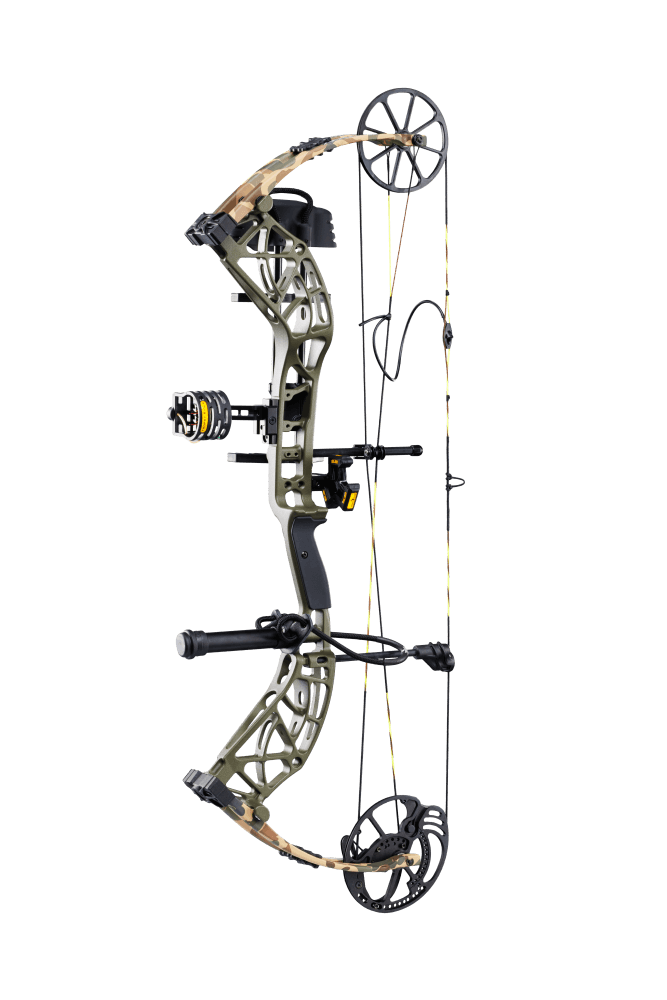
Adapt 2 RTH (The Hunting Public)
2024 model
Compare the Bear Adapt 2 RTH (The Hunting Public)
Spec-by-spec, CareScore-driven head-to-heads against every rival in the category.
Get more from your budget compound bow
Save & share this breakdown
The pin-ready spec card for the Bear Adapt 2 RTH (The Hunting Public) — auto-generated from the same scored data as this page.
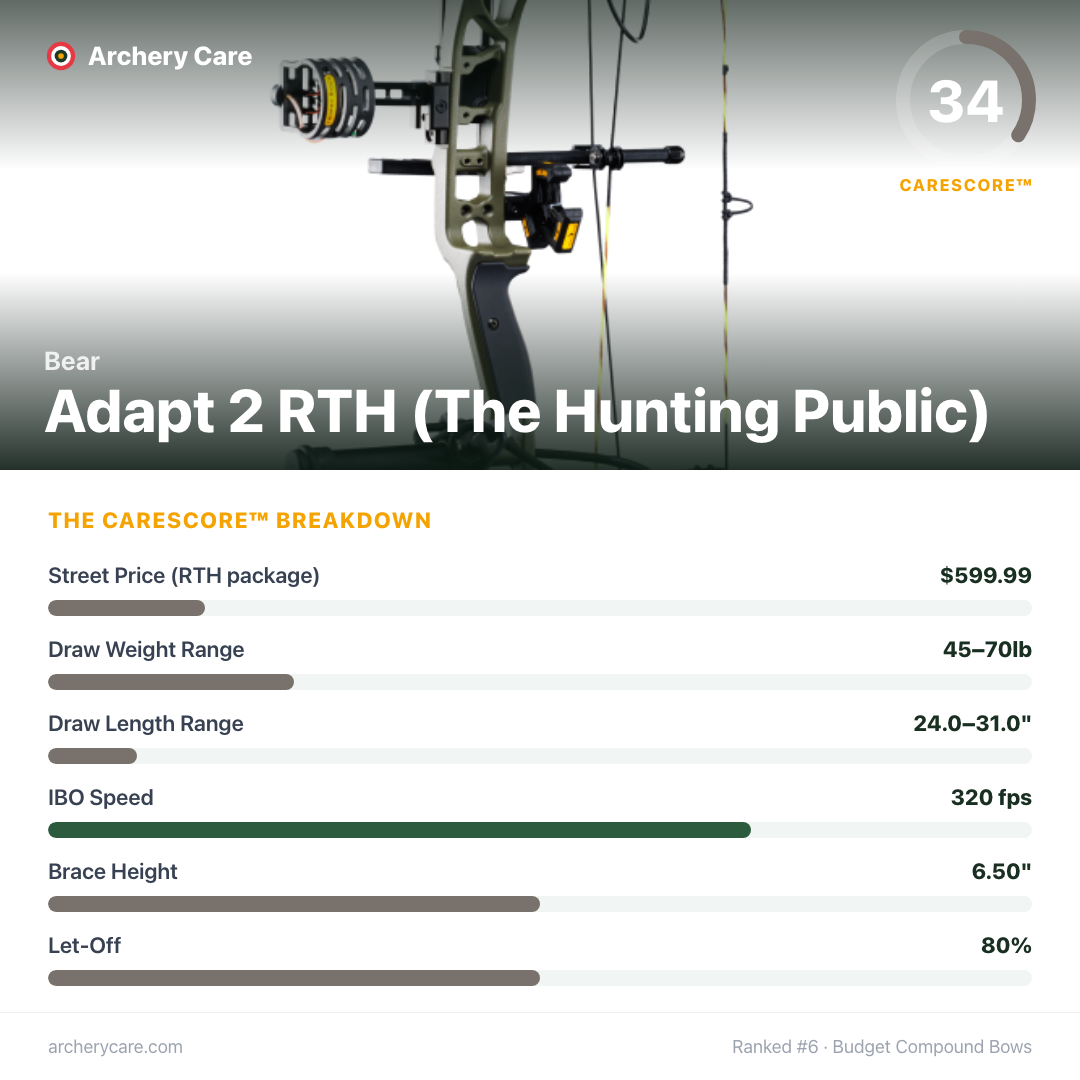
Pin it, post it, or drop it in a group chat — the score, the top specs and the source travel with the image. When this page’s data updates, the card regenerates automatically.