Recurve Bow vs Crossbow: Skill Project or Hunting Tool?
A recurve is a lifelong skill with a $150 entry price; a crossbow shoots like a rifle and costs ten times more to start. The right pick depends on whether you want to compete someday or fill a tag this fall.
By the Archery Care Editorial Team
Watch it done
Reputable tutorials that demonstrate this, hand-picked by Archery Care. The walkthroughs are the creators’ own — we just point you to the good ones (and, where they added chapters, straight to the moment that matters).
Buy a recurve if you want a sport. Buy a crossbow if you want venison. That's the comparison in two sentences — the rest is detail, but it's detail worth getting right before you spend anywhere from $150 to $2,500.
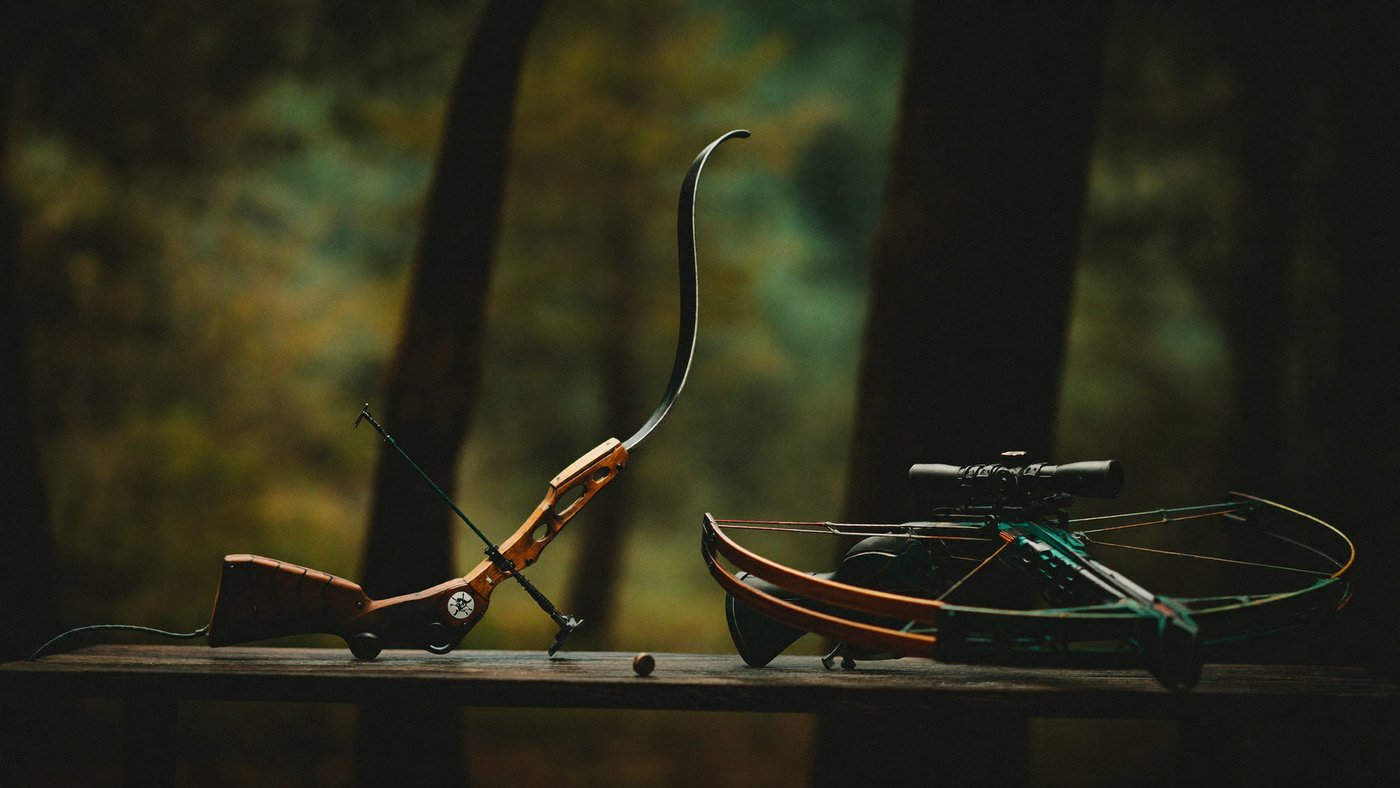
A recurve makes you hold the full draw weight on your fingers, aim without magnification, and build form for months before your groups tighten. A crossbow gets cocked once, rests on sticks or a rail, and aims through a scope. One is a discipline. The other is equipment.
Whatever you choose, fit beats brand. Measure your draw length — or run it through a draw length calculator — before ordering recurve limbs, because draw length changes both the fit and the actual holding weight you'll carry on your fingers.
The skill ceiling isn't even comparable
Nobody maxes out a recurve. Olympic archers shoot 70 meters at a 122-centimeter target face whose 10-ring measures just 12.2 centimeters — about the width of a grapefruit, at roughly three-quarters of a football field — and World Archery's set system means whole matches swing on a single arrow. The curve never flattens. Release timing, back tension, wind reading, nerves: there's always another layer to fix.
Crossbows top out fast. Once a TenPoint TX 440 is sighted in, it sends arrows downrange at 440 fps with rifle-style repeatability, and the marksmanship transfers straight over from any scoped firearm. Most new owners shoot usable hunting groups within a weekend. That's not an insult — it's the entire point of the tool. But if you're chasing a skill that can absorb decades, it lives on the recurve side.
Effort, week by week
Your fingers will ache the first week. A recurve gives you no let-off and no mechanical help — you hold every pound at full draw, and a 30-pound bow feels like twice that after sixty arrows. Coaches typically start adults light and move up slowly, which is why a takedown like the Galaxy Sage sells limbs from 20 to 55 pounds. You will outgrow your first set. That's by design.
Crossbow effort is front-loaded into one motion. Crank systems like TenPoint's ACUslide handle cocking and, just as important, safe de-cocking; the budget-tier Barnett Hyper Raptor 410 ships with a rope-sled cocker in the box. After that you're holding a seven-pound rifle-shaped object. Fatigue won't limit your practice sessions. Boredom might.
Hunting practicality
Crossbows win this category, and it isn't close. They stay cocked for hours in a treestand, shoot well off a rest, and current models run from 360 fps on the budget Killer Instinct SWAT X1 up to 515 fps on the TenPoint TRX 515 — trajectories flat enough that a few yards of range misjudgment rarely costs you the shot.
With a hunting recurve, it does. Traditional bowhunters generally keep shots inside 20 yards and pass on anything marginal, because an arrow shot off your fingers, without sights, demands certainty. That's a beautiful constraint if you love the craft. It's a frustrating one if you mostly want meat.
One caveat that overrides everything above: regulations. Some states allow crossbows through the full archery season; others restrict them to firearms season or to disability permits. Read your state's rules before buying anything. And whichever platform you pick, check your arrow weight and broadhead setup against a KE/FOC calculator so you know the energy actually arriving at the animal.
Cost of entry runs backwards
Here's where the ranking flips. A complete Galaxy Sage — riser, limbs, string, rest — costs $149.98 at Lancaster Archery, and roughly $250 total gets you arrows, a finger tab, and an armguard on top. Cheapest entry in archery, full stop. The expensive recurve is the competition recurve: build an Olympic-style rig around a Hoyt Xceed 2 or WIAWIS ATF-DX riser, add carbon limbs, stabilizers, a clicker, and the Easton X10 arrows that dominate Olympic shooting lines, and you'll clear $2,000 without trying.
Crossbows start expensive and stay there. The Hyper Raptor 410 is the value pick — scope, quiver, and three arrows in one package — while flagships like the TX 440 list around $2,500 and Ravin's R500 sits in the same bracket. Budget extra for broadheads and a target actually rated to stop a 400-plus fps bolt; standard bag targets often aren't.
Compound bows split the difference — current hunting flagships run $1,300 to $2,149 — and something like a Bear Redeem buys treestand practicality without giving up the act of drawing a bow.
Olympic path vs hunting path
Only one of these can take you to the Games. Recurve has been the lone Olympic bow style since archery returned to the program at Munich in 1972. Compound finally gets a mixed-team event at LA 2028; crossbow has never appeared and there's no sign it will. If a 70-meter line is the ambition — yours or your kid's — the decision is already made. Find a World Archery-affiliated club, start on light limbs, and plan in years.
The hunting path runs the opposite direction. Sight in the crossbow, practice from your actual stand height, learn shot placement on the species you're after, go. Plenty of crossbow hunters fill a tag their first season. A recurve hunter's first season is usually spent practicing.
Which one to buy
Decide on the next twelve months, not the fantasy version of yourself.
- You want to compete, or want a skill you'll keep for decades: recurve. Start with the $150 Sage — it teaches the same form a $2,000 riser does.
- You want to hunt this fall with limited practice time: crossbow. Skip the flagship and spend the difference on good arrows and broadheads.
- You're drawn to real archery but plan to hunt seriously: that's the compound's lane, not either of these.
Real questions archers ask about choosing between a recurve bow and a crossbow
Mined from public archery communities (June 2026); answered by Archery Care using our scored data. Source links go to the original discussions.
Can I even use a crossbow during archery season, or is it treated like a gun?
It depends entirely on where you hunt, and this catches a lot of beginners out. Some states fold crossbows into the full archery season for everyone, others restrict them to firearms or 'primitive weapon' seasons, and several only let you use one during archery season if you're over a certain age (often 60 or 65) or hold a disability permit. Rules also flip on minimum draw weight, arrow length, and even fps caps. Before you spend a dollar, pull up your state wildlife agency's current regs and read the weapon definitions line by line. Forum posters repeatedly warn that hearsay and outdated threads will get you a citation.
I have a shoulder or back injury. Is a crossbow my only realistic option?
It's a common reason people switch, and honestly it's a good one. Drawing and holding 45 to 60 pounds repeatedly is hard on shoulders, elbows, and backs, and plenty of hunters move to a crossbow after an injury or surgery rather than quit. A crossbow stays cocked until you fire, so the strain happens once when you load it, not every time you aim. That said, don't write off a vertical bow entirely. Lighter draw weights, let-off on compounds, and a crank cocking aid on a crossbow all reduce load. If the injury is the deciding factor, the crossbow is the pragmatic call, not a cop-out.
Which is actually less hassle to maintain and fix myself?
Here's where a recurve quietly wins. A recurve, whether a stick bow or a recurve-limb crossbow, lets you swap a string with a simple stringing aid and a spare you can carry in your pack. No press, no shop visit. A compound or compound-style crossbow stores its energy in cams, and a damaged string usually means specialized tools, real skill, or a trip to a pro shop, which costs money and downtime. So if self-reliance and a field-fixable setup matter to you, that's a point for recurve gear. If you'd rather have the speed and flatter trajectory and don't mind shop maintenance, the compound side makes sense.
My kid wants to start. Crossbow or recurve for a young beginner?
Age and strength decide this more than anything. A nine or ten year old often can't pull enough draw weight to ethically hunt deer with a vertical bow, which is exactly why crossbows get recommended for younger hunters off a rest or shooting sticks. But for genuinely little kids, say under seven or eight, a light recurve is the better call. It's simple, safe to handle, and teaches real form early, plus it's just more fun to plink at balloons with. Watch the fit too: most non-reverse-draw crossbows are nose-heavy and awkward for small frames, so size the equipment to the child rather than handing them an adult setup.
Will starting on a crossbow ruin me for ever learning a real bow later?
No, and the worry is mostly backwards. A crossbow and a hand-drawn bow use almost completely different skills, so time on a crossbow doesn't build bad habits that carry over to a recurve. It just doesn't build the relevant ones either. The flip side from the forums is more interesting: archers say a good recurve shooter switches to a compound far more easily than the other way around, because the recurve forces you to nail grip, anchor, and release with no mechanical safety net. So if your long-term goal is hand-drawn archery, you'll learn more starting there. If your goal is filling a tag this fall, the crossbow gets you there faster with no penalty.
Community Pulse
What owners and shoppers actually say, quantified across 7 public discussions reviewed in June 2026.
A crossbow gets a beginner hunting accurately far faster than any hand-drawn bow
praiseThis is the near-consensus. Posters describe taking a complete novice and having them shoot tight groups at 50 yards within half an hour, versus the months a recurve demands before you reliably hit a target at all. The recurring caveat: a crossbow is heavy and bulky to lug around, and a few hunters found that after a season their real-world comfortable range was no further than a practiced compound shooter's.
A crossbow isn't really archery and shouldn't share the archery season
mixedTraditional shooters argue a crossbow is a different machine using different skills, closer to a short-range gun than a bow, and resent it sharing archery dates. Others counter that it's still launching an arrow under muscle-stored energy and opens hunting to kids, seniors, and the injured. For a beginner the takeaway is practical, not philosophical: the label won't matter, but the season and equipment rules tied to it absolutely will.
Recurve gear is simpler and cheaper to keep running than a crossbow
mixedFans of recurve-style equipment point out you can change a string in the field with a stringing aid and a cheap spare, while compound crossbows need a press, tools, or a shop. The pushback is that compound crossbows reward you with more speed, a flatter trajectory, and quieter, easier cocking. So 'simpler' and 'better performing' pull in opposite directions, and which one wins depends on whether you value self-reliance or downrange ballistics.
How we counted: we read 7 public discussions across archery forums and communities, grouped recurring topics, and counted distinct threads (not comments) where each theme appeared favorably or critically. Summaries are paraphrased in our own words; every count links to its sources. Note: Discussion concentrates on ArcheryTalk (buy-decision and legality threads); the skill-vs-tool and accessibility angles surface most on Rokslide's hunting board, while the 'is it even archery' debate lives on TradTalk. Reddit excluded per instructions.