Types of Bows: The 4 Families and How to Pick Yours
Every bow on the market falls into one of four families — recurve, compound, longbow/traditional, and crossbow. Here's what each does best, where compound cam systems differ, and which family actually fits you.
By the Archery Care Editorial Team
Watch it done
Reputable tutorials that demonstrate this, hand-picked by Archery Care. The walkthroughs are the creators’ own — we just point you to the good ones (and, where they added chapters, straight to the moment that matters).
Four families cover every bow on the market: recurve, compound, longbow and its traditional cousins, and crossbow. Which one you should buy depends less on your budget than on what you want archery to be — an Olympic-style discipline, a hunting tool, a piece of living history, or something closer to a rifle.
Get the family right first. The model comes later, and it matters less than you think.
Most manufacturers now put binary or modified-twin systems on their flagship lines, so the market has largely voted. Honestly, cam type should be the last box you tick — fit matters far more than the system, and a draw length calculator gets you the first number you need in under a minute.
An hour at a local club beats any spec sheet — most ranges will put a recurve and a compound in your hands in the same session. And if you'd rather answer five questions than drive somewhere, the Find My Bow quiz does the same triage.
Recurve: the Olympic track
Watch any Olympic archery final and you're watching recurves — it's the only bow family shot at the Games. The limbs curve away from the archer at the tips (hence the name), which stores more energy than a straight limb and, per World Archery, sends arrows downrange at over 200 kph. Competitors shoot 70 meters at a target face 122 centimeters across.
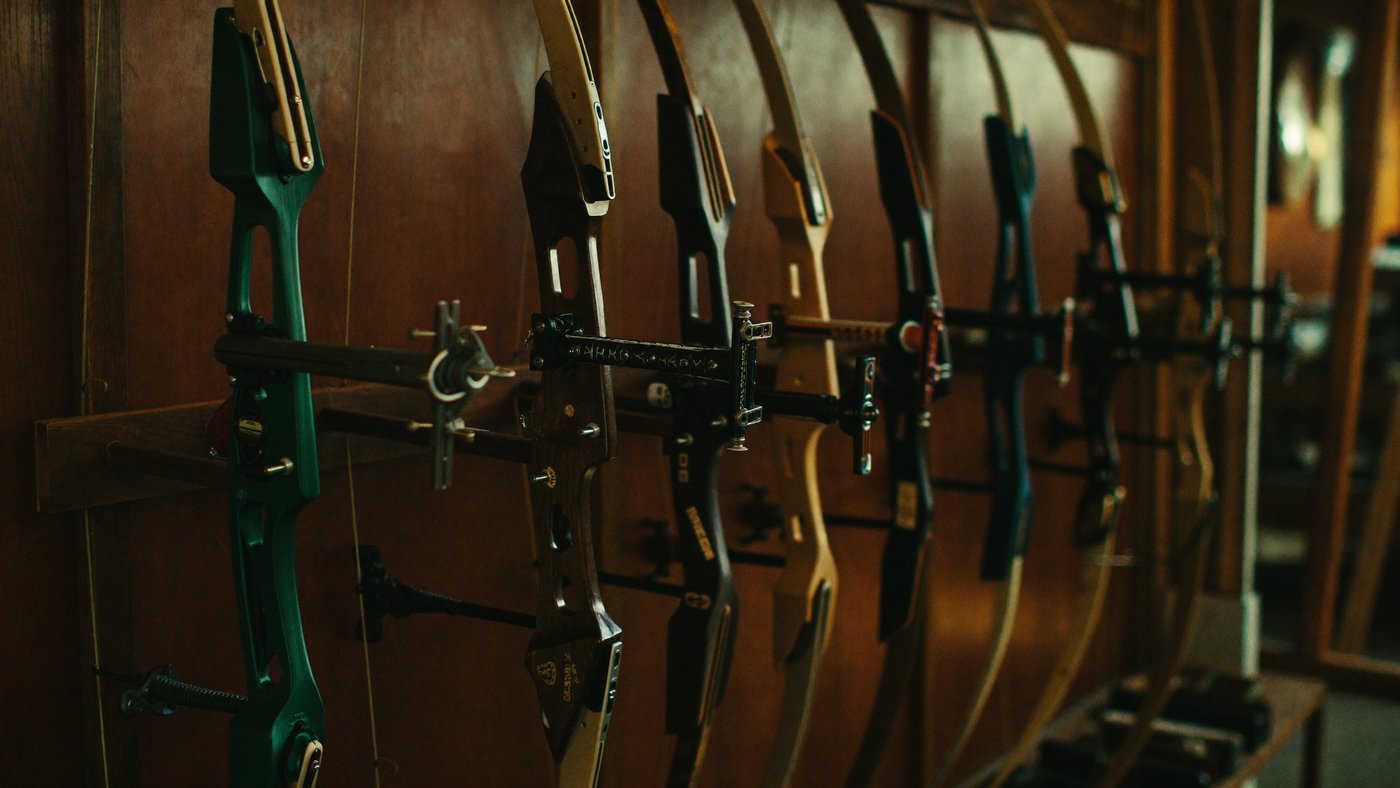
Modern recurves are takedown bows: a central riser plus two detachable limbs. That's the best thing about them. Buy one riser, then swap in stiffer limbs as your strength and form improve, instead of replacing the whole bow.
Start cheap. The Samick Sage (sold as the Galaxy Sage in some shops) has been the default first bow for years, and nothing about it will hold you back through your first couple of seasons. When you're ready to compete, risers like the Hoyt Xceed 2 or WIAWIS ATF-DX are where serious target money goes.
This is the family for beginners, target archers, and anyone who wants a path that leads — however theoretically — to the Olympics.
Compound bows do the holding for you
A compound swaps simple limbs for a system of cams and cables. Draw it back and the cams roll over, so at full draw you're holding only a fraction of the bow's peak weight. That's called let-off, and it changes everything: you can settle in, breathe, and aim through a magnified sight while triggering a mechanical release.
The design only dates to the 1960s — World Archery didn't recognize it until the 1990s — but it now dominates bowhunting outright. Current flagships such as the Mathews ARC 34, Hoyt Carbon RX-10, and PSE Sicario Carbon FDS advertise IBO speeds between 338 and 357 fps and run $1,300 to $2,149. You don't need to spend that. The Bear Redeem covers the same job for hunters on a budget.
Compounds suit hunters first, and anyone who wants tight groups without shooting five days a week.
The four compound cam systems
Cam design is where compound shopping gets confusing, so here's the short version.
- Single cam. One elliptical cam on the bottom limb, a round idler wheel up top. Nothing to synchronize, so it stays in tune longer and needs less maintenance — at the cost of some speed. The low-fuss choice.
- Twin cam. The oldest layout still in use: identical cams top and bottom. Fast, with dead-level nock travel, but the two cams drift out of sync over time and need periodic timing work.
- Hybrid cam. Hoyt's cam-and-a-half system made this one famous — a control cam replaces the idler wheel. Close to twin-cam speed, close to single-cam maintenance once it's set up.
- Binary cam. Bowtech's contribution. The cables attach cam-to-cam rather than to the limbs, so each cam is slaved to the other and timing self-corrects. Level nock travel and low hand shock; the trade-off is cam lean that can take shimming to tune out.
Longbows and traditional bows
Then there's the bow that started it all. A longbow is a tall, D-shaped stave — often a single piece of wood or a wood-and-fiberglass laminate — with a string. No sight. No stabilizers. Sometimes not even an arrow shelf.
You aim by feel, or by reading the arrow point against the target. It's slow to learn and the misses pile up early; most archers find their groups open up dramatically the first time they put down a sighted bow. Your string fingers will complain for the first couple of weeks too.
That difficulty is the point. Traditional archers shoot because the bare process — draw, anchor, loose — is the whole reward. Competition homes exist: World Archery runs longbow and instinctive divisions in 3D archery, and its barebow class (a recurve stripped of accessories, which must pass through a 12.2-centimeter ring unstrung) is the bridge between traditional and Olympic-style shooting.
If you want maximum challenge for minimum gear cost, pick this family.
Crossbows sit apart
Crossbows are the odd family out — World Archery doesn't recognize or regulate them at all. The limbs sit horizontally on a rifle-style stock; you draw once, usually with a cocking rope or crank, the trigger mechanism holds the string, and you aim through a scope.
That changes the skill equation completely. There's no draw to manage at the moment of the shot, so accuracy comes quickly. Speeds are in another league as well: the current crop runs from 360 fps at the entry level, in units like the Killer Instinct SWAT X1, up to 515 fps from the TenPoint TRX 515, with the Ravin R500 just behind.
The honest downsides: they're heavier and louder than any vertical bow, follow-up shots are slow, and hunting rules vary wildly by state — some allow crossbows for the full archery season, others don't. Check your regulations before you check out.
A crossbow makes the most sense for hunters with shoulder injuries, limited practice time, or a settled preference for aiming like a rifle.
So which one?
Still torn? Quick gut check:
- You want to learn real form, maybe compete, or just spend the least money finding out if archery sticks — takedown recurve.
- You want to hunt, or you want tight groups without a big practice budget — compound.
- You care more about the experience than the score — longbow or traditional.
- You need rifle-like aiming, or drawing a vertical bow isn't physically on the table — crossbow.
Real questions archers ask about the types of bows
Mined from public archery communities (June 2026); answered by Archery Care using our scored data. Source links go to the original discussions.
I've settled on a recurve, but should I get a takedown (ILF) or a one-piece?
For a first recurve, go takedown ILF nine times out of ten. The reason is poundage. You'll almost certainly start too heavy, and with ILF you just unbolt the limbs and swap in lighter or heavier ones for around $80 instead of buying a whole new bow. It also lets you tune limb alignment and tiller as your form sharpens. The trade-off, as TradTalk regulars point out, is that all that adjustability invites tinkering and setup errors that can confuse a newcomer. One-piece bows are simpler, livelier in the hand, and there's no hex key to lose, but they lock you into one draw weight. If you want a clean, no-fuss trad experience, a one-piece is lovely. If you want room to grow, ILF wins.
What draw weight should I actually start with, regardless of bow type?
Lighter than your ego wants. The number-one mistake new archers make is buying too much poundage, and forums see it constantly. For a recurve, 20-25 lbs is plenty to learn on, and many coaches start adults on 14-18 lb limbs. A 6-foot-5 lifter and a petite teenager should both start around 25-30 lbs and earn their way up. For a compound, set the draw weight low enough that you can pull it straight back while sitting, no skyward heave required. Overbowing forces you to hunch, snap-shoot, and yank with your arm instead of your back, and those bad habits calcify into target panic and sore shoulders. Form comes from repetition, and you can't repeat a weight you're fighting. Start light, dominate the bow, then climb.
Does starting on a recurve make me a better archer if I switch to compound later?
There's real truth to it, with a caveat. A recurve hides nothing. With no let-off and no mechanical aid, sloppy back tension, a creeping release, or a torqued grip shows up instantly on the target. Learn to shoot one cleanly and you've drilled the fundamentals (posture, anchor, follow-through) that transfer to any bow. Plenty of archers say the recurve-first path made their later compound shooting easier. The caveat: a recurve is also slower and more frustrating to reach a satisfying level with, and that frustration washes some beginners out entirely. If staying in the sport depends on seeing early results, the forgiveness of a compound may keep you shooting long enough to build those fundamentals anyway. Neither path is wrong. The best bow is the one that keeps you on the line.
I just want to hunt. Should I skip a vertical bow and get a crossbow?
If your only goal is filling a tag with the least practice, a crossbow gets you there fastest. It's point-and-shoot, holds itself cocked, and a beginner can be deadly at 40 yards in an afternoon. But know the trade-offs before you commit. Crossbows are heavy (around 6 lbs versus 3 to 3.5 for a compound), loud, slow to reload, and bulky to haul up a treestand. Check your state regs too, since seasons and legality vary. The bigger question is what you actually want from bowhunting. Hunters on the forums are blunt: if you enjoy the process (the draw, the discipline, the closer shots), a vertical bow is far more rewarding long-term. If it's purely a tool to harvest with limited time to practice, the crossbow earns its keep.
Should I buy my first bow used to save money, or is that a beginner trap?
Used can be smart, but it depends on the family. A used ILF recurve riser is a great buy. Risers rarely wear out, and you control the limbs you bolt on. Used limbs are riskier since hairline cracks and delamination aren't always visible, so inspect tips and edges closely. Compounds are where beginners get burned: an older model may need a press, new strings, or cams that no shop still services, and a bargain that won't tune is no bargain. If you go used compound, buy something recent enough that your local shop can set the draw length and weight for you. Whatever the type, get it measured and fitted to your draw length before you trust it. A perfectly good bow that's the wrong size will teach you nothing but bad habits.
Community Pulse
What owners and shoppers actually say, quantified across 6 public discussions reviewed in June 2026.
Beginners should learn on a recurve first to build clean fundamentals
mixedA loud camp argues the recurve's unforgiving nature forces good form from day one, so skills transfer cleanly if you later move to compound. The pushback is just as strong: a recurve's slow progress and high practice demand frustrate newcomers, and a compound's forgiveness can keep someone in the sport long enough to learn anyway. Most threads land on the same truce: bow family matters less than light poundage and good coaching.
Draw weight, not bow type, is the decision that actually matters
praiseThis is the closest thing to consensus across all three forums. Whether the thread starts as recurve-vs-compound or which-model, experienced archers steer it back to one point: start light. Overbowing breeds hunching, snap-shooting, and target panic, and it injures shoulders and elbows. The repeated refrain is to go lighter than you think, master the bow, then add weight. Nobody seriously argues the other side.
For hunting, ease and success rate should drive the choice over romance
mixedAmong hunters the split is about goals. One side says if filling a tag is the measure of success, start with a compound or even a crossbow because trad bows demand closer shots and far more practice. The other side insists that if traditional archery is what excites you, just start there rather than detouring through a compound. Both agree romance shouldn't override honest expectations about range and skill.
How we counted: we read 6 public discussions across archery forums and communities, grouped recurring topics, and counted distinct threads (not comments) where each theme appeared favorably or critically. Summaries are paraphrased in our own words; every count links to its sources. Note: Discussion concentrates on ArcheryTalk and TradTalk beginner-bow threads, with Rokslide carrying the hunting-specific trad-vs-compound debate. The single loudest recurring point across all three forums is that draw weight, not bow family, is what wrecks beginners.