Ripcord Ratchet Cable-Driven (Micro)
Exceptional
Ranked #2 of 8 arrow rests
$179.99
Ripcord — now sold under the Black Gold Accessories umbrella — built the Ratchet around one clever idea: Speed Set Technology, a ratcheting dial that takes up activation-cord slack without a bow press. That turns the worst part of owning a cable-driven rest into a ten-second job. The micro-adjust standard-mount version was $179.99 at Lancaster. Full-capture fork launcher, anti-bounce-back, and the launcher locks up for extra arrow security.
Standout feature: Speed Set ratchet dial tunes cable take-up in seconds, no bow press — nobody else in this group does that.
The verdict
The Ripcord Ratchet Cable-Driven (Micro) earns a CareScore of 85.3/100 (exceptional), ranking #2 of 8 arrow rests we’ve scored at $179.99. Speed Set ratchet dial tunes cable take-up in seconds, no bow press — nobody else in this group does that.
Scored by the published CareScore v1.1.11 methodology from manufacturer specs, June 2026.
Pros
- Cord tension adjustment via ratchet dial — no press, no re-serving, setup under 5 minutes
- Micro-adjust windage and elevation on this SKU
- Full-capture fork launcher with anti-bounce-back, lockable in the up position
- Padded launcher and overmolded containment arm keep the draw quiet
- Offered in standard Berger and IMS dovetail mounts; made in USA
Cons
- Micro version costs $30-40 over the standard Ratchet (from $169.99 base at Black Gold)
- Brand transition to Black Gold Accessories makes older Ripcord SKUs and pricing confusing at retail
- Backordered at Lancaster at time of research
- Cable-driven still means the cord attaches to the down cable — more invasive than limb-driven
Real questions archers ask about the Ratchet Cable-Driven (Micro)
Mined from public archery communities (June 2026); answered by Archery Care using our scored data. Source links go to the original discussions.
Has anyone actually run the Ratchet cable-driven rest, and is it built better than older Ripcords like the Code Red?
Owner reports are mixed, and that's worth knowing before you buy. The Speed Set ratchet dial genuinely makes setup fast — several call it the easiest drop-away they've installed because it tensions the cord with no press. But there are recurring complaints about tiny lock/set screws stripping, side-to-side play developing over a season, and materials feeling cheaper since the brand changed hands. Some owners get hundreds of flawless arrows; others went back to QAD or Hamskea.
How noisy is the Ratchet in a hunting situation compared with a QAD?
Mixed, depending on who you ask. Owners upgrading from older Ripcords say the Ratchet is noticeably quieter than its predecessors, but one multi-season shooter found it loud in the field. If field noise is your top priority, a well-set QAD HDX has the longer, quieter track record; the Ratchet's edge is install speed, not silence.
Are you running the cable-driven or the limb-driven version of the Ratchet?
Both exist and the community mixes them freely — the Ratchet is sold as one platform in cable-driven and limb-driven variants. The cable-driven micro is the one with the speed-set dial doing the cord take-up; the limb-driven skips the cable serving. If you want to avoid cable work entirely, the limb-driven; if you like the dial-tensioned cable system, the cable-driven micro. Just know reviews lump them together, so read carefully.
Is the Ratchet lighter than the Code Red and other older Ripcord rests? The weight spec is hard to find online.
Vapor Trail keeps the exact weight quiet, but a shooter who phoned the company for a live weighing on the related Pro-VX got about 2.7 oz — so the family runs light. For the Ratchet specifically the spec is hard to pin down; owners describe it as competitive rather than a standout. If grams matter that much, weigh yours on a kitchen scale once it arrives.
Why am I getting fletching contact on the cable-driven Ratchet when timing checks out on a draw board, and is there a way to adjust how far the launcher drops?
If timing checks out on a draw board and you're still getting contact, look at how far the launcher actually drops and whether a set screw has shifted — owners report tiny screws backing out and throwing timing off badly enough to send arrows through the prongs. Make sure every lock screw is secure (threadlocker helps), then confirm the launcher fully clears before the fletching arrives. It's usually hardware creep, not the core design.
Why can't I tune out a nock-low bareshaft tear after installing the Ratchet — does the ratchet take-up dial need to be fully set before tuning?
Set the ratchet take-up dial fully before you start tuning — if the cord tension isn't locked in, your launcher timing shifts as the dial settles and a nock-low tear won't come out. Get the dial set, confirm timing on a draw board, then bareshaft tune. If it still won't resolve after that, you're in the camp that pushed some owners back to QAD or Hamskea, and a different rest may be the answer.
Why does Ripcord get so little love in rest recommendations compared with QAD and Hamskea — real quality problem or just brand fashion?
Mostly brand fashion stacked on a real wobble in quality. After the ownership change, several owners say materials got cheaper and the brand rarely gets recommended against the QAD/Hamskea duopoly. But the warranty experiences skew positive — free replacement screws and launcher upgrades come up — so it's not a write-off. It's a capable rest from a brand rebuilding trust, which is exactly why it gets less love than its specs deserve.
Community Pulse
What owners and shoppers actually say, quantified across 4 public discussions reviewed in June 2026.
Ratchet-dial setup ease
mixedSeveral owners call it the easiest drop-away they've ever set up because the dial tensions the cord without a press, and the micro clicks are praised as crisp; a vocal minority counters that the ratchet solves a problem that never existed, can bind if not tightened correctly, and the protruding lever can brush the bow hand in hunting positions.
Small-parts and build quality
criticismRecurring complaints about tiny, fragile lock/set screws that strip or won't stay secure — in one case throwing off timing badly enough to send arrows through the prongs — plus a plastic launcher that pulled its screws out on a limb-driven unit, and a broader gripe that materials were cheapened after the brand changed hands.
Long-term reliability and drop consistency
mixedPlenty of owners report hundreds of trouble-free arrows and six-plus months of consistent operation, but a similar number describe the launcher failing to return to the down position after a few shots, side-to-side play developing over a season, a bearing going out, or an unresolvable nock-low tune that pushed them back to QAD or Hamskea.
Noise
mixedUsers who upgraded from earlier Ripcord models say the Ratchet is noticeably quieter than its predecessors, but one multi-season owner found it loud in the field, and prospective buyers burned by noisy older Ripcords keep asking about it before committing.
Warranty service and brand perception
mixedWarranty experiences skew positive — free replacement set screws and a free launcher upgrade get mentioned, and the warranty itself is cited as a buying reason — but the brand's reputation took a hit after the ownership change, with users saying Ripcord is rarely recommended against the QAD/Hamskea duopoly and one reporting friction actually reaching support.
How we counted: we read 4 public discussions across archery forums and communities, grouped recurring topics, and counted distinct threads (not comments) where each theme appeared favorably or critically. Summaries are paraphrased in our own words; every count links to its sources. Note: Discussion of the cable-driven Micro SKU specifically is sparse; the community treats "the Ratchet" as one platform sold in cable-driven and limb-driven variants and mixes them freely in threads. Only one thread (the March 2026 ArcheryTalk thread) is squarely about the cable-driven version, and even there several replies describe the limb-driven model — some cited failures (bearing wear, plastic launcher pulling screws) are explicitly limb-driven, so they speak to platform build quality rather than this exact SKU. The 'Ripcord Ratchet fail' thread never states the variant. No Ratchet-specific threads were found on Reddit (r/bowhunting), and Rokslide mentions were limb-driven only, so they were excluded per the disambiguation warning; HuntingNet/Bowsite threads were about older pre-Ratchet Ripcord models and were also excluded. All four included threads are ArcheryTalk, fetched and read in full (the site paywalls bot traffic, so they were retrieved with a browser user agent). No community discussion was found about the brief's Lancaster backorder or the Micro-vs-standard price delta. Counts are distinct threads and intentionally conservative.
CareScore breakdown
How the 85.3/100 was built. Each spec is normalised to a 0–100 quality score, then weighted.
Data note: $179.99 is Lancaster's price for the standard-mount micro SKU; other retailers ranged $159.95 (Walmart) to $209.99 (Podium Archer). ripcordarrowrest.com now 301-redirects to blackgoldaccessories.com. Release year not published; current in the 2026 lineup.
Full specifications
| Street Price | $179.99 |
|---|---|
| Micro-Adjust | Yes |
| Rest Type | Cable-driven-dropaway |
| Containment | Full |
| Mounting | Both |
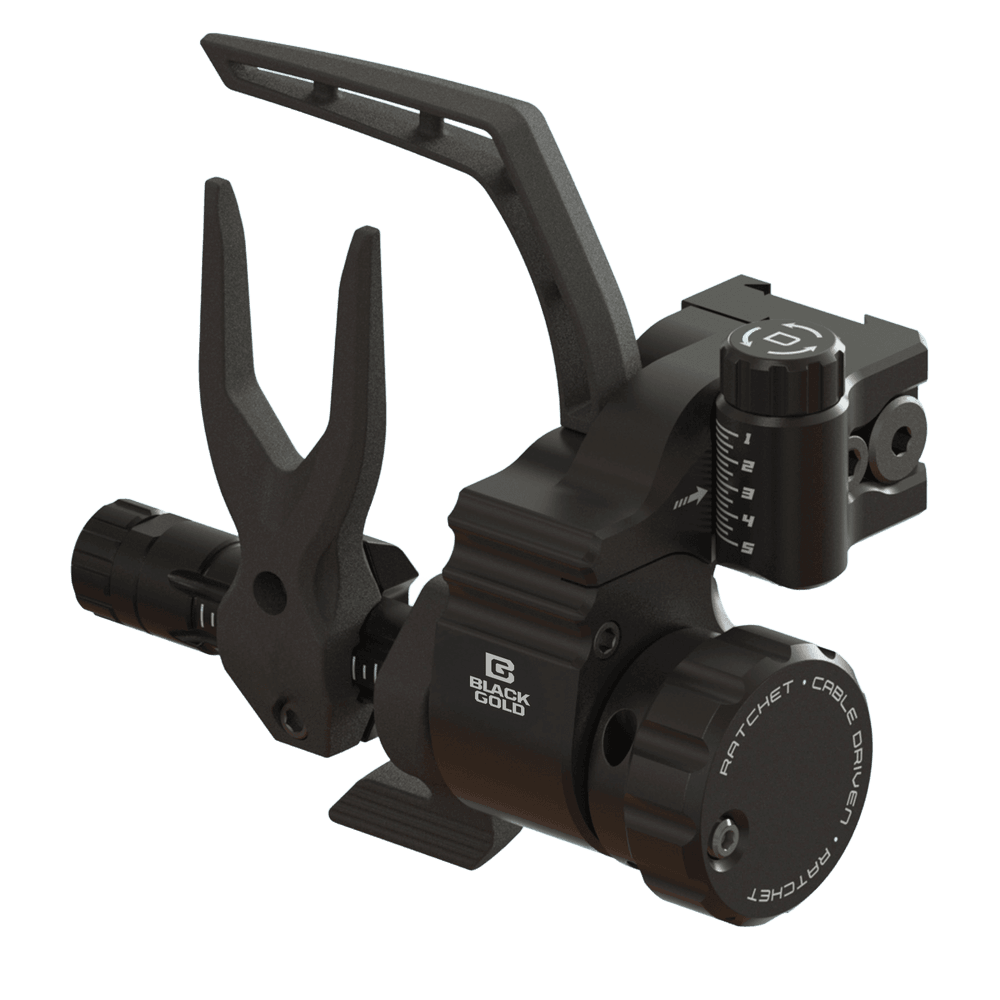
Ratchet Cable-Driven (Micro)
Compare the Ripcord Ratchet Cable-Driven (Micro)
Spec-by-spec, CareScore-driven head-to-heads against every rival in the category.
Where the Ratchet Cable-Driven (Micro) ranks
Get more from your arrow rest
Save & share this breakdown
The pin-ready spec card for the Ripcord Ratchet Cable-Driven (Micro) — auto-generated from the same scored data as this page.
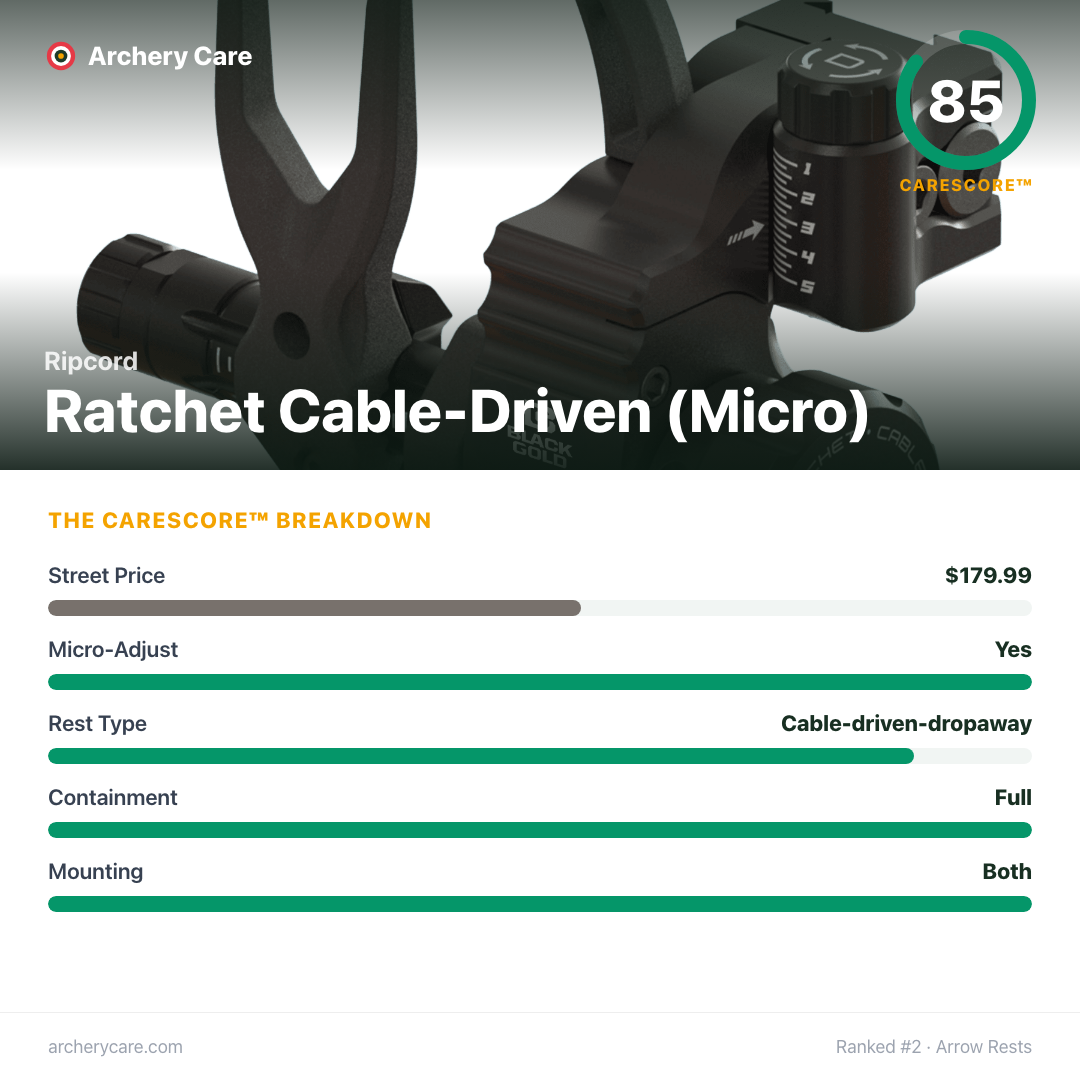
Pin it, post it, or drop it in a group chat — the score, the top specs and the source travel with the image. When this page’s data updates, the card regenerates automatically.