CBE Trek Pro (5-pin)
Exceptional
Ranked #2 of 8 bow sights
$344.99
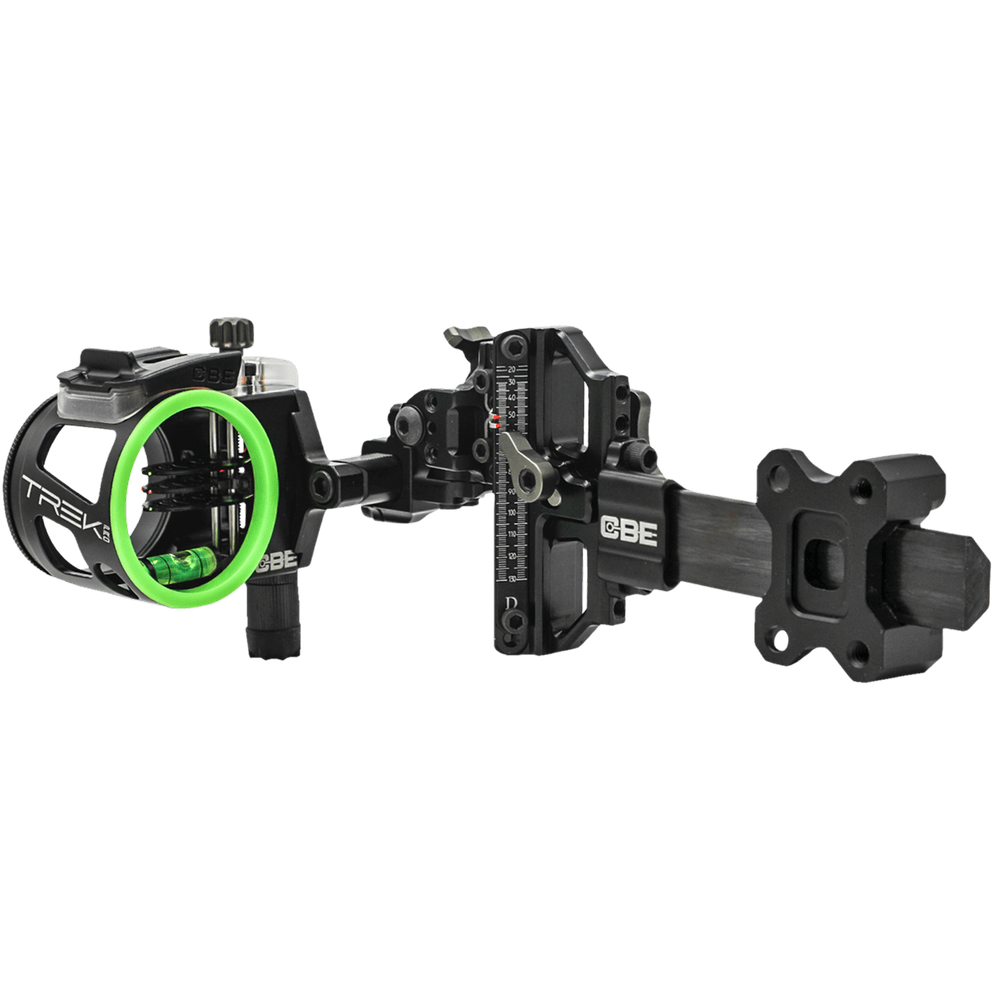
The Trek Pro is the value sneak of the hybrid class. Carbon dovetail bar, full three-axis adjustment, micro-adjustable blade pins and CBE's Rapid Drive elevation — feature-for-feature it shadows sliders that cost $100+ more, and the light is already in the box. The 5-pin weighs 11.4 oz, undercutting most aluminum rivals.
Standout feature: Flagship slider features — carbon bar, micro pins, Rapid Drive — at a mid-tier price with the light included.
The verdict
The CBE Trek Pro (5-pin) earns a CareScore of 87.0/100 (exceptional), ranking #2 of 8 bow sights we’ve scored at $344.99. Flagship slider features — carbon bar, micro pins, Rapid Drive — at a mid-tier price with the light included.
Scored by the published CareScore v1.1.11 methodology from manufacturer specs, June 2026.
Pros
- Carbon fiber dovetail bar keeps the 5-pin at 11.4 oz
- Rapid Drive elevation with a dead stop for your top pin
- Micro-adjustable blade pins and micro windage with engraved marks
- Sight light included — premium brands charge extra for that
Cons
- CBE doesn't publish the dovetail bar length
- Resale and shop support lag Spot Hogg and Black Gold
- Sight-tape setup (sight in at 30 and 60, then pick a tape) adds a step versus mark-your-own
Real questions archers ask about the Trek Pro (5-pin)
Mined from public archery communities (June 2026); answered by Archery Care using our scored data. Source links go to the original discussions.
Can you mount an aftermarket scope like an Ultraview on the Trek Pro, and is the windage rod compatible?
Yes — owners run aftermarket scopes like the UltraView on the Trek Pro, and the windage rod uses a standard size that makes those swaps work. It's part of why the sight gets called good value: you're not locked into CBE's own optics. Confirm your specific scope's mounting standard, but UltraView mounting is a well-trodden path on this sight.
Does the Trek Pro fit the Mathews Bridgelock mount, or do you need an adapter?
It fits a Bridge-Lock setup but check which base you're ordering — CBE sells dovetail and mount-specific versions, and Bridge-Lock risers want the matching bar rather than a generic dovetail. Owners do run it on Mathews Bridge-Lock bows. Order the Bridge-Lock-compatible configuration up front rather than trying to adapt a standard dovetail.
Why are my mid-range yardages off after sighting in at 20/30 and 60 and picking a factory sight tape — am I doing the tape setup wrong?
Usually the tape, not you — this is the Trek Pro's most divisive area. Some owners find the laser-engraved metal tapes dead-on at every yardage; others got mid-range misses from the 30/60 process and ended up making their own tapes. If your 20 and 30 are perfect but 50 is off, your arrow speed doesn't quite match the factory tape you picked. Tape your own marks at known distances and the problem disappears.
How does the Trek Pro stack up against Spot Hogg, Black Gold, HHA, B3, and Axcel sights in quality and customer service?
The recurring verdict: the Trek Pro delivers flagship features — micro pins, metal tapes, axis adjustment, light weight — at a price that undercuts an Axcel Landslyde or Spot Hogg by a wide margin, with the light included. Where it trails: Spot Hogg and HHA have the edge on bombproof durability and US manufacturing (CBE is now TOG-owned with overseas production), and their shop support is deeper. If value-per-feature is the goal, the Trek Pro wins; if you want the toughest sight that shrugs off abuse, the premium brands still lead.
Is the Trek Pro solidly built — any vibration, rattle, or durability problems in the field?
Mostly solid — most owners call it sturdy, vibration-free and tight in its adjustments, and one 5-pin owner calls it bombproof. The honest caveat is QC consistency: a vocal minority reports housing rattle out of the box. If yours arrives with any rattle, trace it to the indicator pins or housing screws and snug them; most units are quiet and stay that way.
How open is the sight picture — do the pins block the target the way a Spot Hogg triple stack can?
The Trek Pro's pin array is on the cleaner side — micro blade pins keep the sight picture reasonably open, and it doesn't crowd the target the way a dense triple-stack can at distance. If an uncluttered picture is your priority, this is a point in its favor over a Spot Hogg triple stack. For the most open picture of all, a single-pin slider beats any multi-pin, but among 5-pins the Trek Pro reads clean.
Is it normal for the slider to overhang the top of the sight at the dead stop, and can you sight in with the slide flush instead?
Yes, that's normal — the slider can overhang the top of the housing at the dead stop, and you can absolutely sight in with the slide flush instead if you prefer that reference. Set the dead stop where your shortest pin lands and work from there. It's a setup preference, not a defect.
How fast and smooth is the elevation wheel — how many rotations top to bottom, and does it have any play?
Be aware the Trek Pro uses a friction-slider elevation rather than a threaded or clicked mechanism, and that's its most-criticized trait among target shooters — one owner reported inconsistent resistance through the travel. For hunting it's a non-issue for most; for precise dialing to exact long yardages, a threaded/geared sight like a Spot Hogg or HHA feels more positive. If you mostly hunt inside 60, the friction slide is fine; if you dial constantly at distance, weigh that.
Community Pulse
What owners and shoppers actually say, quantified across 9 public discussions reviewed in June 2026.
Build quality and QC consistency
mixedMost owners call the Trek Pro sturdy, vibration-free, and tight in its adjustments — several rate it among the best hunting sliders out and one 5-pin owner calls it bomb proof — but a vocal minority reports rattling housings, returned units, and a finish level a step below B3 or Spot Hogg.
Value for money
praiseRepeated refrain that the feature set (micro pins, metal tapes, axis adjustments, light weight) undercuts an Axcel Landslyde or Spot Hogg by a wide margin; owners mention grabbing it on sale around $250 and saying it can't be beat for the money.
Sight-tape system (30/60 sight-in, metal tapes)
mixedThe laser-engraved metal tapes split the room: some find them dead-on at every yardage and more accurate than HHA's, while others got mid-range misses from the 30/60 process and resorted to making their own tapes, and one owner found the engraved markings hard to read in low light.
Setup complexity and thin instructions
criticismFirst-time setup draws complaints: the tape procedure confuses people, indicator pins twist in their track when tightened, and Rokslide owners wished for more setup videos and better instructions — though one B3-thread poster said the process clicked after a couple read-throughs.
Friction-slider elevation feel
mixedTarget-oriented shooters knock the elevation for being a friction slider rather than a threaded or clicked mechanism, with one reporting inconsistent resistance through the travel; a multi-sight owner countered that the rail is rock solid and smooth.
Overseas manufacturing and TOG ownership
criticismSeveral posters factor in that CBE is now TOG-owned with production moved overseas — phrases like 'built well considering where it's built' recur, and some prefer HHA or B3 specifically for US manufacture; one Rokslide regular likes CBE 'notwithstanding where they're manufactured.'
How we counted: we read 9 public discussions across archery forums and communities, grouped recurring topics, and counted distinct threads (not comments) where each theme appeared favorably or critically. Summaries are paraphrased in our own words; every count links to its sources. Note: Platform-vs-variant ambiguity is the main caveat: forum discussion covers the Trek Pro platform (1-pin, 2V, 3V, 5-pin variants share the bar, slider, scope, and tape system), and several threads are anchored on other variants. Explicit 5-pin Trek Pro owner reports appear in three threads (Rokslide 3V/2V, the 'How's the trek pro 2 v?' thread, and 'CBE Trek sight…..') and are uniformly positive. One post in 'CBE Trek sight…..' is from a non-Pro Trek 5-pin owner and was used only to confirm the Pro's micro-adjust pins are a real differentiator — the non-Pro Trek is a distinct cheaper model, so wrong-model bleed was screened for. Reddit yielded nothing: multiple targeted searches plus a direct old.reddit query found no r/bowhunting or r/Archery threads on this sight, so the brief's Reddit venue is effectively empty — CBE talk lives on ArcheryTalk and Rokslide. A Bowsite thread on the Trek Pro Micro 3V exists but sits behind a Cloudflare challenge and could not be read, so it is excluded. All nine listed threads were actually fetched (ArcheryTalk via direct request, as its bot route 402-paywalls) and read; counts are distinct threads, counted conservatively. Discussion volume is moderate, not huge — themes 5 and 6 rest on 3-4 threads each.
CareScore breakdown
How the 87.0/100 was built. Each spec is normalised to a 0–100 quality score, then weighted.
Data note: $344.99 across 1/3/5-pin configs on CBE's own site (June 2026); retail search listings ranged $319.99–$359.99. Pins .010 or .019; 1-pin 10.3 oz, 3-pin 11.0 oz. 14 laser-engraved aluminum sight tapes per earlier retailer copy (CBE page says 'yardage scales' without a count). 2024 launch year is from CBE's Trek-series rollout — verify before publishing. Newer Trek Pro 2V ($329.99) and Trek Pro Micro 3V ($349.99) vertical-pin variants are also current.
Full specifications
| Street Price | $344.99 |
|---|---|
| Axis Adjustment | First-second-third |
| Mounting | Dovetail |
| Adjustment Precision | Micro |
| Sight Light Included | Yes |
| Pin Count | 5 |
| Pin Size | 0.019" |
Trek Pro (5-pin)
2024 model
Compare the CBE Trek Pro (5-pin)
Spec-by-spec, CareScore-driven head-to-heads against every rival in the category.
Where the Trek Pro (5-pin) ranks
Get more from your bow sight
Save & share this breakdown
The pin-ready spec card for the CBE Trek Pro (5-pin) — auto-generated from the same scored data as this page.
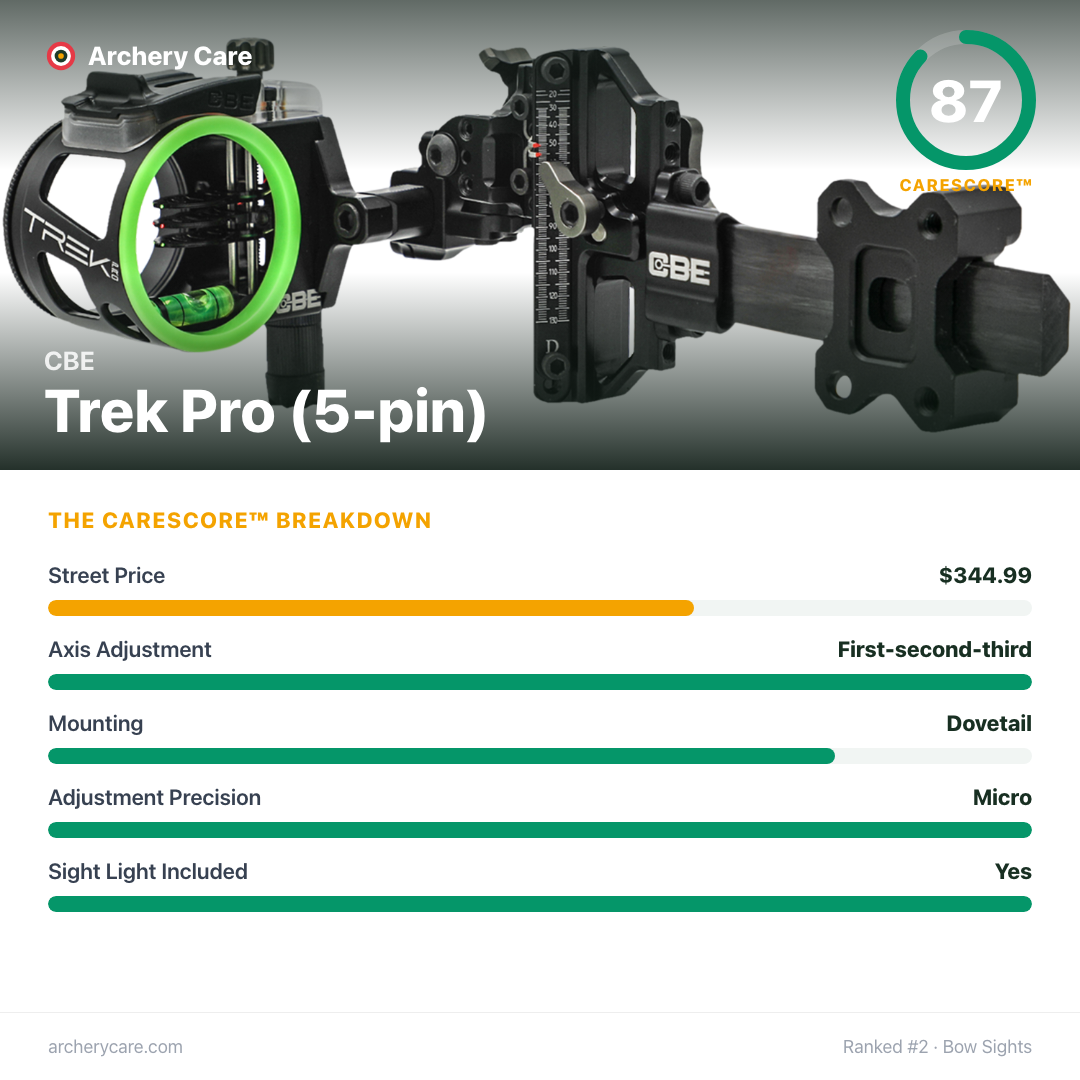
Pin it, post it, or drop it in a group chat — the score, the top specs and the source travel with the image. When this page’s data updates, the card regenerates automatically.