Hoyt Carbon RX-10
Fair
Ranked #8 of 8 compound bows
$2,149
Hoyt's premium carbon halo bow: light, warm-handed and now far easier to tune thanks to the press-free XTS system. For the buyer who wants the lightest top-tier hunting rig.
Standout feature: Carbon riser plus the new patent-pending XTS press-free left/right and high/low tuning system.
The verdict
The Hoyt Carbon RX-10 earns a CareScore of 41.9/100 (fair), ranking #8 of 8 compound bows we’ve scored at $2,149. Carbon riser plus the new patent-pending XTS press-free left/right and high/low tuning system.
Scored by the published CareScore v1.1.11 methodology from manufacturer specs, June 2026.
Pros
- Lightweight, warm carbon riser
- Press-free XTS tuning is a genuine advance
- Top-tier fit and finish
Cons
- The most expensive bow in the class
- Carbon premium over the near-identical aluminium AX-3
Real questions archers ask about the Carbon RX-10
Mined from public archery communities (June 2026); answered by Archery Care using our scored data. Source links go to the original discussions.
Is the Carbon RX-10 worth the premium over Hoyt's aluminium AX-3?
The community is genuinely split: a vocal contingent on ArcheryTalk and Rokslide can't justify the roughly $600 step up from the near-identical aluminium AX-3 for a similar listed mass weight, while carbon loyalists defend the warm grip and dead post-shot feel. Notably, several shooters who tested both back-to-back ended up ordering the AX-3. Our assessment points the same way on value: at $2,149 the RX-10 is the most expensive bow in its class and carries a CareScore of 41.9/100, ranking #8 of 8 in its category.
I already own an RX-9 — is upgrading to the RX-10 worth it?
Most replies say no if your RX-9 is already tuned: owners who handled the RX-10 report the platform and cams are essentially carried over, with the press-free XTS tuning hardware in the limb pockets being the headline change. A smaller group who shot it argue the new tuning system alone justifies the move. At $2,149, the honest framing from the threads is that you would be paying flagship money primarily for easier tuning.
Does the new XTS press-free tuning system actually matter?
The XTS system handles left/right and high/low adjustments without a bow press, and several experienced shooters across these threads call it the best tuning setup currently on the market — especially for people who tinker with arrow builds. The pushback is practical rather than technical: some owners note most people only tune at string changes and question the day-to-day value, and a few prefer PSE's simpler shim approach. Nobody in the threads we read reported problems with the hardware itself, though it is a first-year, patent-pending system.
How does the RX-10 compare with the PSE Mach 30/33 FDS?
Owners who shot both generally describe the PSE as lighter, slightly faster and noticeably smoother to draw, while giving the Hoyt the edge on post-shot deadness, balance, grip, fit-and-finish and tuning adjustability. Several long-time Hoyt shooters in these threads ordered the PSE this year, citing the draw cycle. On paper the RX-10 is rated 342 fps with a 6.125-inch brace height, 30.5-inch axle-to-axle and a 4.4 lb mass weight.
Is the carbon riser's warm-to-the-touch benefit real in cold weather?
Owner reports conflict. Cold-country and western hunters who carry the bow in hand call the warm grip a real benefit, and one southern owner added that carbon also stays grabbable in summer heat where aluminium does not — but another who shot in 25-degree weather found the carbon barely warmer than aluminium in practice, and several note a thin glove solves the problem for free. If your bow mostly sits on a hanger in a treestand, the community consensus is that the benefit is marginal.
Community Pulse
What owners and shoppers actually say, quantified across 6 public discussions reviewed in June 2026.
Carbon premium over the near-identical aluminium AX-3
mixedThe single biggest debate. Many shooters say the roughly $600 carbon upcharge buys only a couple of ounces and a warmer grip, and several who shot the RX-10 and AX-3 back-to-back bought the aluminium bow. Carbon defenders counter with the dead post-shot feel, warm/cool-touch riser and pride of ownership; a few recommend buying last year's carbon at closeout instead.
XTS press-free tuning system
mixedBroadly praised — multiple experienced shooters, including self-described non-Hoyt fans, call it the best tuning system on the market and a genuine reason to buy. A skeptical minority argues tuning is a one-and-done task for most hunters, prefers PSE's simpler shim system, or worries new tuning gadgetry adds complexity.
Incremental update over the RX-9
criticismEarly adopters who handled the bow report it is essentially an RX-9 with the limb-pocket tuning hardware added, and launch-thread reaction included words like underwhelming. RX-9 owners are widely advised to keep their bows or buy discounted RX-9s; defenders respond that the platform was already excellent and a tuning system is exactly what people had asked for.
Shootability: draw cycle and post-shot feel
mixedRange reports praise a smooth draw that shoots lighter than its poundage and a riser that is dead at the shot with excellent balance and hold. On the critical side, shooters comparing it against PSE's FDS cams consistently found the PSE noticeably smoother, and one owner reported an unpleasant stiff spot at the end of the RX-10's draw cycle that the AX-3 didn't have.
Flagship pricing
criticismSticker shock is a recurring reaction — posters balk at a price tag starting with a 2, note rivals cost $500+ less, and one Rokslide poster summed the new Hoyts up as heavier, slower and more expensive than the competition on paper. The main counterpoints are buy-once-cry-once reasoning and chasing discounted prior-year carbon models instead.
How we counted: we read 6 public discussions across archery forums and communities, grouped recurring topics, and counted distinct threads (not comments) where each theme appeared favorably or critically. Summaries are paraphrased in our own words; every count links to its sources. Note: All substantive discussion found was on ArcheryTalk (5 threads) and Rokslide (1 thread), concentrated in the weeks after the bow's November 2025 announcement. Targeted searches for Reddit discussion (r/bowhunting, r/Archery) surfaced no RX-10-specific threads and direct Reddit fetches were blocked, so Reddit sentiment is not represented in this report. ArcheryTalk's bot gateway (Tollbit) returned
Video answers
Questions answered in BowHunterPlanet’s video review of the Hoyt Carbon RX-10, summarized by Archery Care — click any question to jump the video to that exact moment.
“Is the 2026 Hoyt Carbon RX 10 Worth It? Full Review & Bowhunter Impressions” · BowHunterPlanet · watch on YouTube
CareScore breakdown
How the 41.9/100 was built. Each spec is normalised to a 0–100 quality score, then weighted.
Data note: Hoyt does not publicly list let-off; 85% is a class-typical figure. Mass weight is a reputable secondary-source figure.
Full specifications
| IBO Speed | 342 fps |
|---|---|
| Brace Height | 6.13" |
| Mass Weight | 4.40 lb |
| Street Price | $2,149 |
| Axle-to-Axle | 30.50" |
| Let-Off | 85% |
| Draw Weight | 40–80lb |
| Draw Length Range | 25.0–30.0" |
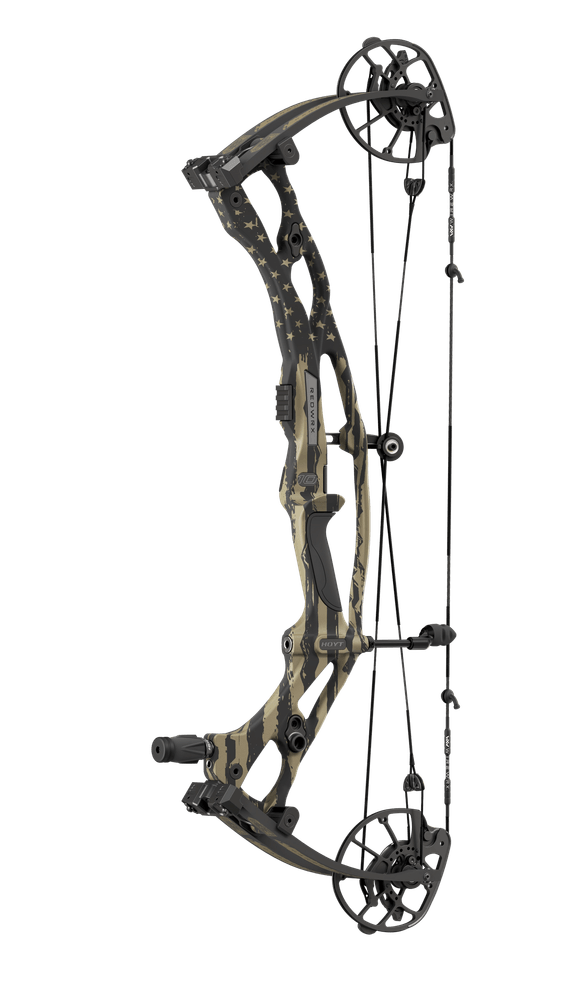
Carbon RX-10
2026 model
Compare the Hoyt Carbon RX-10
Spec-by-spec, CareScore-driven head-to-heads against every rival in the category.
Get more from your compound bow
Save & share this breakdown
The pin-ready spec card for the Hoyt Carbon RX-10 — auto-generated from the same scored data as this page.
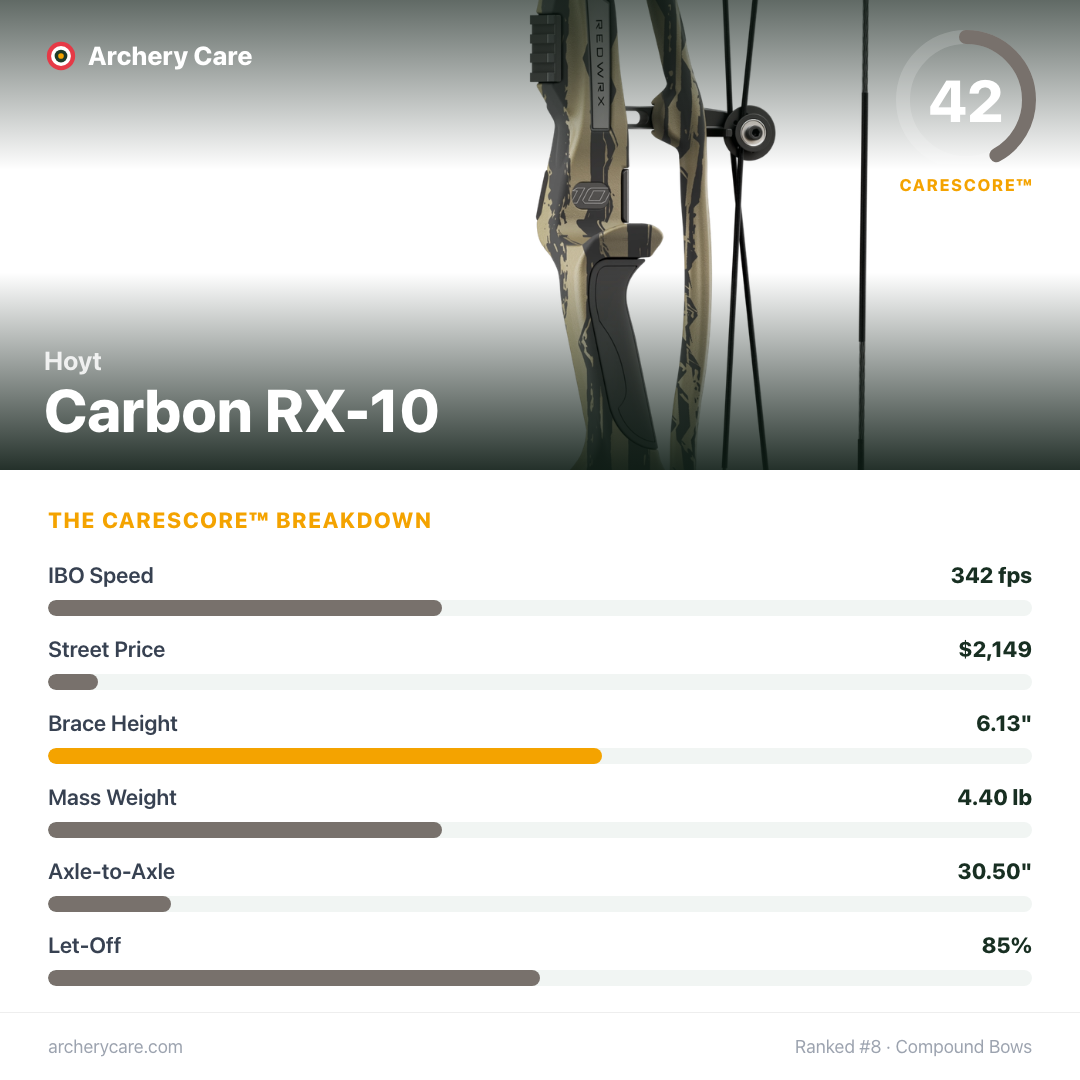
Pin it, post it, or drop it in a group chat — the score, the top specs and the source travel with the image. When this page’s data updates, the card regenerates automatically.