How to Increase Draw Weight Without Wrecking Your Shoulders
Build draw weight with SPT holds, band volume, and rowing work in the gym — then move up 2 lb at a time, giving each jump four to eight weeks. Overbowing costs you accuracy now and a shoulder later.
By the Archery Care Editorial Team
Watch it done
Reputable tutorials that demonstrate this, hand-picked by Archery Care. The walkthroughs are the creators’ own — we just point you to the good ones (and, where they added chapters, straight to the moment that matters).
Buying a heavier bow and gutting it out is the slowest way to add draw weight — and the most likely to end in a rotator cuff problem. The fast way is training the muscles that actually hold a bow at full draw — rhomboids, mid and lower traps, rear delts — with SPT holds, band volume, and a short list of gym lifts, then stepping up 2 lb at a time.
Give each jump four to eight weeks. That's the training-block length USA Archery recommends for SPT work, and it matches how long your connective tissue needs to catch up. Muscle adapts in days. Tendons don't.
If that list sounds familiar, drop back to the last weight you could hold cleanly and rebuild through the SPT ladder. That costs a few weeks. Grinding bad form into your nervous system while your rotator cuff files complaints costs a season.
Not sure where your starting weight and draw length should sit in the first place? Run the draw length calculator and the Find My Bow quiz before you order limbs. Strength training works far better when you're building from a number your body already owns.
Start with SPT holds
SPT stands for specific physical training, the protocol Coach Kisik Lee brought to USA Archery's national program. The version that builds draw weight is the holding SPT: draw your bow with no arrow, settle into your full anchor, and hold. USA Archery's published protocol is 10 to 30 seconds at full draw followed by 40 to 60 seconds of rest, repeated through the session. Lee's own program pushes harder — holds of 30 seconds to a full minute, rest for double your hold time, ten repetitions, building toward 30-minute sessions. His elite archers do this five days a week.
Never release the string. Holding without an arrow is fine; letting go is a dry fire, and dry fires kill bows. Point at a target butt anyway.
The progression trick is clever. Once you can hold 45 seconds comfortably, Lee's protocol has you loop rubber bands over the limbs — that adds roughly 2 to 3 lb of resistance without buying anything. When the banded bow feels easy too, you've earned the real upgrade.
There's a power variant worth adding: draw, hold three to five seconds, let down to your setup position without releasing, draw again. Five to twelve reps, three to five sets, three to five minutes between sets. It feels like nothing on rep two and like everything on rep nine.
Band work fills the gaps
Stretch bands look like toys. They're not. USA Archery starts archers under 11 on bands alone and keeps 12-to-15-year-olds on lightweight bows, because a band teaches the drawing motion without loading joints that aren't ready for it. The same logic works for adults: a band gives you extra draw cycles on days you can't get near the range.
Keep one at your desk. A set of clean, slow draw cycles during a coffee break costs nothing, rehearses back tension, and adds weekly volume your shoulders barely notice. You also can't overbow yourself with a band, which makes it the one tool here with no downside.
Pull more than you push in the gym
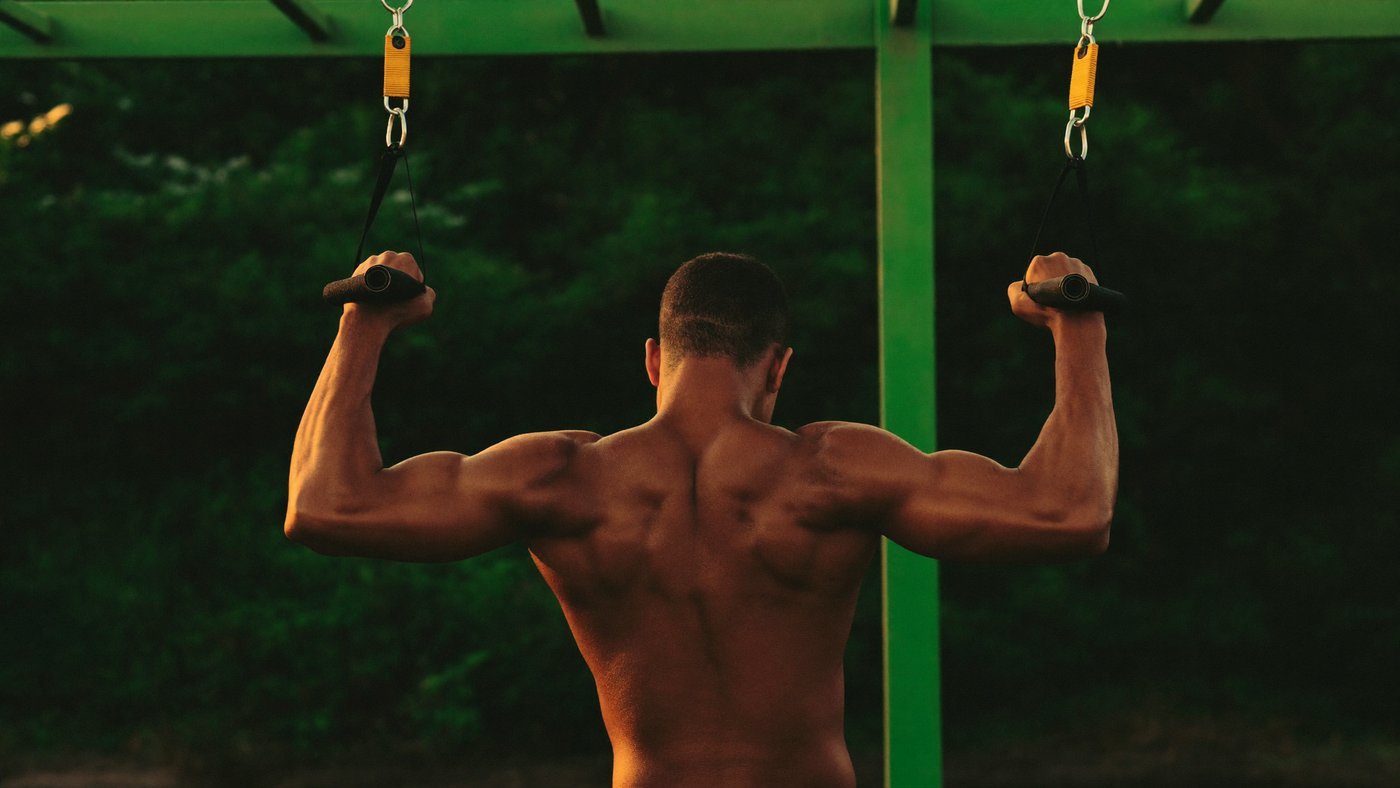
Drawing a bow is a horizontal pull that ends in a long scapular squeeze, so train it like one. Single-arm dumbbell rows are the closest match — one side pulling while your core resists rotation, just like at full draw. Add face pulls and rear-delt flyes with a light band or cable; they hit the posterior deltoid and the external rotators that keep a shoulder healthy under repeated load. Inverted rows round out the list if you've got a bar.
Go lighter than your ego wants. Sets of 10 to 15 with a deliberate squeeze at the end beat heavy singles, because you're building holding endurance, not a one-rep max. Two or three gym days a week is plenty. Skip the bench-press arms race — pressing strength won't hold an anchor, and overdeveloped pecs drag your shoulders into exactly the rounded posture good archery form fights against.
Move up 2 lb at a time
Two pounds. Not five. Glasgow Archers' coaching guidance puts it bluntly: creep up the poundages 2 lb at a time, and only once the current weight is genuinely comfortable — meaning your last end of the session looks as steady as your first.
On a recurve that means swapping limbs, which is why a takedown riser earns its keep — a Galaxy/Samick Sage or a Hoyt Xceed 2 accepts new limbs without replacing the whole bow. On a compound, back the limb bolts out when you buy, so you've got room to grow into the bow's range before you need new hardware.
Know where the ladder tops out, too. Most male recurve archers do fine peaking around 35 to 40 lb and women around 30 to 35; professional Korean women shoot high-30s to low-40s, and top male pros run 45 to 50. Compounds are capped at 60 lb peak weight under Archery GB and World Archery rules. There's no medal for poundage.
Overbowing will find you out
An overbowed archer is easy to spot. Usually from across the field.
- Shaking at anchor before the shot breaks, especially late in a session
- Sky-drawing — pointing the bow upward to cheat the first inches of the pull
- Groups that open up sharply after the first few ends
- A sore shoulder the next morning instead of tired muscles between the shoulder blades
- Failing the basic test: a steady 30-second hold at full draw without trembling
Real questions archers ask about archery strength training
Mined from public archery communities (June 2026); answered by Archery Care using our scored data. Source links go to the original discussions.
How do I actually know I'm ready to go up, not just guessing?
Stop guessing and run a hold test. A coach's version that gets passed around the forums: draw to full anchor and hold for seven seconds, let down for two, and repeat seven times. If your bow arm starts shaking, your draw shoulder creeps up toward your ear, or that last rep is a grind, you're not ready. The cleaner read is your shooting itself: if your current weight has zero effect on your groups when you're tired, near the end of a session, or cold, you've got headroom. If your last few arrows of a round always drift, the weight you have is already winning. Earn the move, don't schedule it.
Is it the heavy poundage that wrecks shoulders, or my form?
It's almost always form first, weight second. A clean shot loads the big back muscles and the skeleton; a sloppy one dumps the load onto the front of your shoulder and the rotator cuff, which is a small muscle group that was never meant to hold a bow at full draw. Hang that bow off your joint instead of your back and it doesn't matter whether it's 45 or 70 pounds, you're on the clock. The pattern people describe is the same: the weight that hurts is the weight that's too heavy to shoot with good structure. Fix the alignment and a lot of 'high poundage' pain just disappears. If it doesn't, the weight genuinely is too much.
My shoulder already aches. Drop weight, or push through and toughen up?
Drop it, full stop. Pushing through a cranky shoulder is how a two-week niggle becomes a season-ending tear, and the cuff heals on a clock you can't speed up. The recovery playbook people land on is boring and it works: peel the poundage right down to something that feels almost too easy, shoot light for a while to rebuild the groove pain-free, then bridge back up in tiny steps. Half a pound at a time isn't being precious, it's letting tendons catch up to muscle. If the ache is sharp, lives deep in the joint, or wakes you at night, see a physio before you touch the bow again. Ego costs more than time off.
What's the warm-up that actually protects the shoulder before I draw?
Bands before bow, every time. The routine hunters swear by is a few minutes of light resistance-band work that isolates the rotator cuff and scapular muscles through their full range, the kind of thing the Crossover Symmetry system is built around, though plain pull-aparts and a cheap band set do most of the job. Treat it as a warm-up, not a workout: enough to get blood into the small stabilizers, not enough to fatigue them. Fair warning that the first week or two will leave those tiny muscles wickedly sore, because you've never trained them directly. That soreness is the point. Do it two or three times a week and the heavy bow stops feeling like a gamble.
Do I even need more poundage, or am I chasing a number?
Be honest about why you want it. For target shooting, more weight buys flatter trajectory and a steadier hold in wind, but only if you can run it without your form folding, and a calmer 45 will out-shoot a wobbly 50 all day. For hunting, the gains are smaller than people think: bumping from 70 to 80 nets you a modest speed and energy bump that a heavier, better-tuned arrow often matches, with way less shoulder tax. The strongest setup is the one you can draw smoothly from an awkward seated angle, in the cold, after sitting still for hours. If accuracy and a clean draw aren't getting better as the number climbs, the number isn't the thing worth chasing.
Community Pulse
What owners and shoppers actually say, quantified across 6 public discussions reviewed in June 2026.
Small increments beat big jumps when stepping up poundage
praiseThe dominant view is patience: nudge up 2 lb at a time, or half a pound when you're chasing precision, and let form lead. Push a big jump and people warn your alignment collapses and bad habits set in. The lighter pushback comes from shooters who jump 5 lb or roughly 10% at once and do fine, usually after a heavy base of reps. Even they agree the move has to be earned by clean shooting, not a calendar.
Heavy draw weight is the main cause of shoulder injuries
mixedSome shooters pin shoulder trouble squarely on high poundage and the long-term toll on the rotator cuff. The stronger counter-argument is that bad structure does the damage: load the joint instead of the back and even a moderate bow hurts, while clean alignment lets people run heavy weights for years. The honest middle ground threads land on is that weight and form aren't rivals, since too much weight is precisely what breaks form down in the first place.
Band-based shoulder prehab is worth adding to your routine
praiseBowhunters are near-unanimous that light resistance-band work for the rotator cuff and scapula, Crossover Symmetry or a budget equivalent, is a genuine game-changer for handling heavier bows, used as a warm-up a few times a week. The only caveat raised is brutal first-week soreness in muscles you've never isolated, which fades fast. Nobody in these threads argues against doing it; the debate is only branded system versus cheap bands.
How we counted: we read 6 public discussions across archery forums and communities, grouped recurring topics, and counted distinct threads (not comments) where each theme appeared favorably or critically. Summaries are paraphrased in our own words; every count links to its sources. Note: Discussion concentrates on ArcheryTalk's draw-weight progression threads and Rokslide's shoulder-prehab threads; TradTalk adds the "light form bow first" school. Two videos verified to reputable channels (Jake Kaminski, Bowmar Bowhunting).