How to Choose the Right Draw Weight for Your Bow
Beginners get draw weight wrong more than any other spec. Here's the hold test, starter bands, and why Olympic recurve has no required poundage — only what you can hold.
By the Archery Care Editorial Team
Watch it done
Reputable tutorials that demonstrate this, hand-picked by Archery Care. The walkthroughs are the creators’ own — we just point you to the good ones (and, where they added chapters, straight to the moment that matters).
Draw weight is the force it takes to pull your bow to full draw, measured in pounds. One number. That's it. And it's the number beginners botch more than anything else — because pulling too much weight will wreck your form before you ever get a chance to build it.
The trap is ego. A bow you can yank back once at the shop isn't a bow you can shoot well for two hours. Too much weight forces the wrong muscles to do the work. Your anchor drops. You start punching the release. And the flinch you pick up in week one can take months to unlearn. Start lighter than you think you need. Everyone says this. Almost nobody listens.
One test that settles it
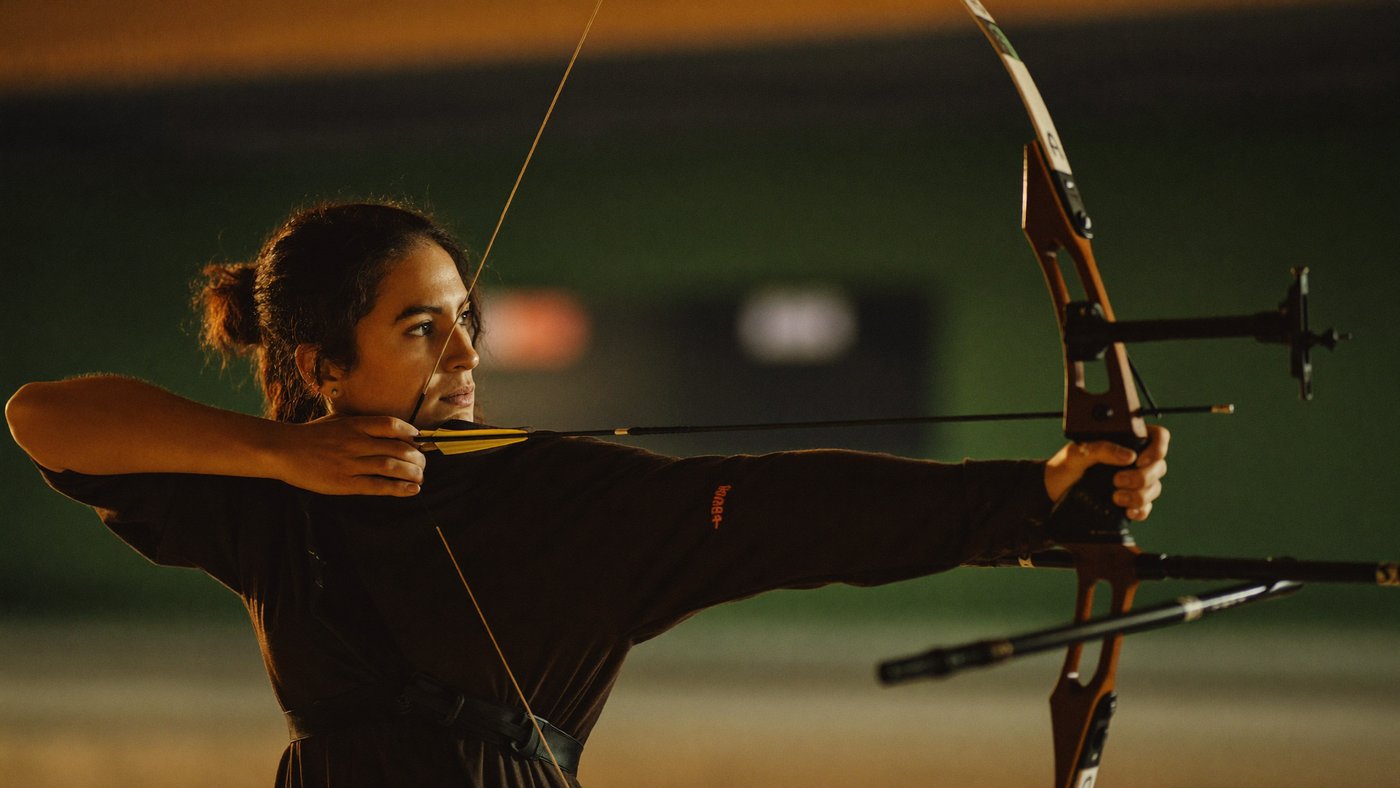
Draw the bow. Settle into your anchor. Now hold it there, steady, for 8–10 seconds. Bow arm shaking? Draw starting to collapse? The weight's too high — full stop. You should also be able to draw smoothly without pointing the bow at the sky to cheat the pull. If the bow's heading for the ceiling on the way back, the weight is winning, not you.
Where to start
- Youth and smaller-framed adults: 10–25 lbs
- Average adult women: 20–30 lbs on a recurve, 30–40 lbs on a compound
- Average adult men: 25–35 lbs recurve, 45–55 lbs compound
Recurve and compound aren't the same fight
A recurve makes you hold the full weight the entire time you're aiming, so the effective effort is higher than the number on the limbs suggests. A compound's cams give you 70–90% let-off — at full draw you're holding only a fraction of the peak. But you still have to get through that peak on the way back, so it has to be manageable too.
Olympic and competition recurve
There is no single required Olympic poundage. You shoot what you can draw and hold cleanly through the full aim. Recurve has no let-off — forty pounds on the limbs is forty pounds on your fingers until the shot breaks.
Start light enough that form stays honest, then climb by swapping ILF limbs on the same riser. That is the whole path. Our recurve buying guide starts first ILF limbs at 18–24 lb. Two-pound jumps, once the current weight holds through a session, is the ladder the strength-training guide already uses. Buy the hunting number first and you will rebuild your shot later.
Published elite numbers are snapshots, not a homework assignment. World Archery's October 2018 piece on the question put the men at that year's World Cup Final around 48–50 lb, and noted Chang Hye Jin won Olympic gold in Rio on 39 lb at the fingers. Brady Ellison dropped from 50 to 47 that year because the limbs were faster and the tune was cleaner. Control beat the extra pounds.
Bow length is a different decision — 66, 68, or 70 inches from your draw length. The size guide has that chart. For the riser itself, the Olympic and competition list ranks ILF handles; limbs are a second bill unless a kit is already noted on the row.
If you plan to hunt
Most US states set a legal minimum for big game — commonly 40 lbs — so check your local regulations before you buy. Shooting targets only? Lighter is genuinely better while you learn. There's no prize for suffering.
Compounds give you room to grow: most adjust across a 10-lb range via the limb bolts or modules, so you can start low and climb as your back and shoulders strengthen. A recurve doesn't work that way — buy lower-poundage limbs first. A replacement set of limbs costs less than rebuilding bad habits ever will.
FAQ
- What draw weight do Olympic recurve archers use?
- Whatever they can hold. There is no required Olympic poundage, and recurve has no let-off, so every pound stays on the fingers through the aim. Start on light ILF limbs — this site's recurve buying guide opens at 18–24 lb — then swap up on the same riser. World Archery's 2018 snapshot put the men at that World Cup Final around 48–50 lb; Chang Hye Jin won Rio gold on 39. Those are published examples, not a target.
- Is there a minimum draw weight for Olympic-style recurve?
- No published World Archery minimum. The 60 lb cap on this site is the compound peak limit, not a recurve floor. US hunting regs often set 40 lb for big game — that is a different sport. The floor that matters is the hold test: 8–10 seconds at anchor without the bow arm shaking or the bow heading for the ceiling.
Go deeper on the words above
Put it into practice
Real questions archers ask about choosing your draw weight
Mined from public archery communities (June 2026); answered by Archery Care using our scored data. Source links go to the original discussions.
Does my draw length change the actual draw weight I'll be pulling?
On a recurve, yes, and it catches a lot of beginners off guard. That "40#" stamped on the limb is measured at a 28-inch draw. Pull longer and you add roughly 2 pounds per inch over 28; come up short and you subtract about the same. So if you have a 31-inch draw, a bow marked 40# is actually closer to 46# in your hands. Compounds work differently. The cams hold peak weight steady across a range of draw lengths, so the number on the sticker is much closer to what you'll feel. Bottom line: if you're long-armed and buying a recurve, size down a few pounds from your target, or you'll end up over-bowed without realizing why.
Once I've started light, how fast can I safely move up in weight?
Slow. The muscles and tendons you use to draw a bow strengthen far slower than your enthusiasm grows, and that gap is where shoulders get hurt. The repeated advice from people who've done it is small, patient jumps: bump up only a couple of pounds at a time, then shoot that weight for a few weeks before going again. On an ILF recurve that means new limbs or a turn of the limb bolts; on a compound, a turn or two of the limb bolts checked against your form. The real test isn't whether you can yank the bow back once. It's whether you can draw, hold, and release with clean back tension for a full session without your form falling apart at the end.
I'm a woman (or buying for one) — should I start lower than the standard beginner numbers?
Usually a touch lower, yes, but treat it as a starting point, not a ceiling. A common rule of thumb is roughly 20# for women and 25# for men as a first bow, since the archery-specific muscles are undeveloped no matter how fit you are elsewhere. That said, strength varies wildly person to person, and plenty of women shoot well above those figures once their form is built. The smarter move than guessing is trying bows at a shop or club and finding the weight you can hold at full draw for 15 to 20 seconds without shaking or straining. Start there, build clean form, then climb. Pull-up strength at the gym doesn't transfer the way you'd expect.
Should I just buy a light bow now and a heavier one later, or get something I can adjust?
For most beginners, buy adjustable rather than buying twice. If you go recurve, an ILF takedown is the move: you start on light limbs, then swap to heavier limbs on the same riser as you grow into the weight, and used limbs sell easily when you're done with them. That's far cheaper than buying a whole new bow in six months. Compounds give you adjustability built in. A bow with a wide poundage range (say 40 to 70#) lets you back the limb bolts all the way down to learn, then crank up gradually. The thing to avoid is buying a fixed-weight bow at the top of what you can manage today, because the day you outgrow it as a beginner is the day you stop using it.
My compound has 80% let-off, so the heavy peak weight barely matters, right?
Let-off helps at full draw, but it doesn't get you off the hook. Yes, an 80% let-off bow set to 60# only holds about 12 pounds once you're anchored, which is why hunters can sit at full draw waiting for a shot. The trap is the part before that. To reach the back wall you still have to break through the full peak weight, and a panicky over-bowed beginner does it by sky-drawing the bow above their head and muscling it down. That's exactly the motion that wrecks shoulders. Set your peak weight so you can draw smoothly, straight back, with the bow pointed at the target the whole time. If you can't, it's too heavy regardless of the let-off number.
Community Pulse
What owners and shoppers actually say, quantified across 7 public discussions reviewed in June 2026.
Almost everyone starts too heavy, and it sets you back
criticismThis is about as close to unanimous as forums get. Thread after thread of experienced archers say going heavy is the single biggest mistake new shooters make, usually because nobody wants to admit a 30# bow is plenty. The recurring regret: a year wasted fighting bad habits baked in by a bow that was too much. The counter-view isn't "start heavy," it's just "don't go so light it's boring" — which still lands well under most beginners' instincts.
Over-bowing is a genuine injury risk, not just a form problem
criticismThese threads get specific and a little grim: rotator cuff tears, biceps tendon fraying, tendonitis. The shared diagnosis is that injuries come less from the weight itself than from how people draw too much weight — sky-drawing, dropping the elbow, muscling with the shoulder instead of the back. The fix everyone repeats is to drop poundage and increase in tiny increments, and to treat any shoulder pain as a stop sign rather than something to push through.
The number on the limb isn't the weight you'll actually pull
mixedPlenty of debate on the math here. The agreed core is that recurve draw weight is rated at 28 inches and shifts roughly 2 pounds per inch of draw, so longer-armed archers quietly end up heavier than the sticker. Where it gets argued is precision — some insist on brace-height formulas, others point out the curve isn't linear once a bow starts to stack near the end of its range. The practical takeaway survives the squabbling: measure or estimate your real weight before buying.
How we counted: we read 7 public discussions across archery forums and communities, grouped recurring topics, and counted distinct threads (not comments) where each theme appeared favorably or critically. Summaries are paraphrased in our own words; every count links to its sources. Note: Discussion concentrates on ArcheryTalk (deepest beginner + injury threads), with TradTalk strong on over-bowing/women's starting weights and Rokslide on the hunting-recurve angle. Reddit excluded per instructions.