What Size Longbow Do You Need? (Draw Length Chart)
Size a longbow from your draw length, not your height. The chart, the wingspan method, and why a too-short longbow 'stacks' into a wall of resistance.
By the Archery Care Editorial Team
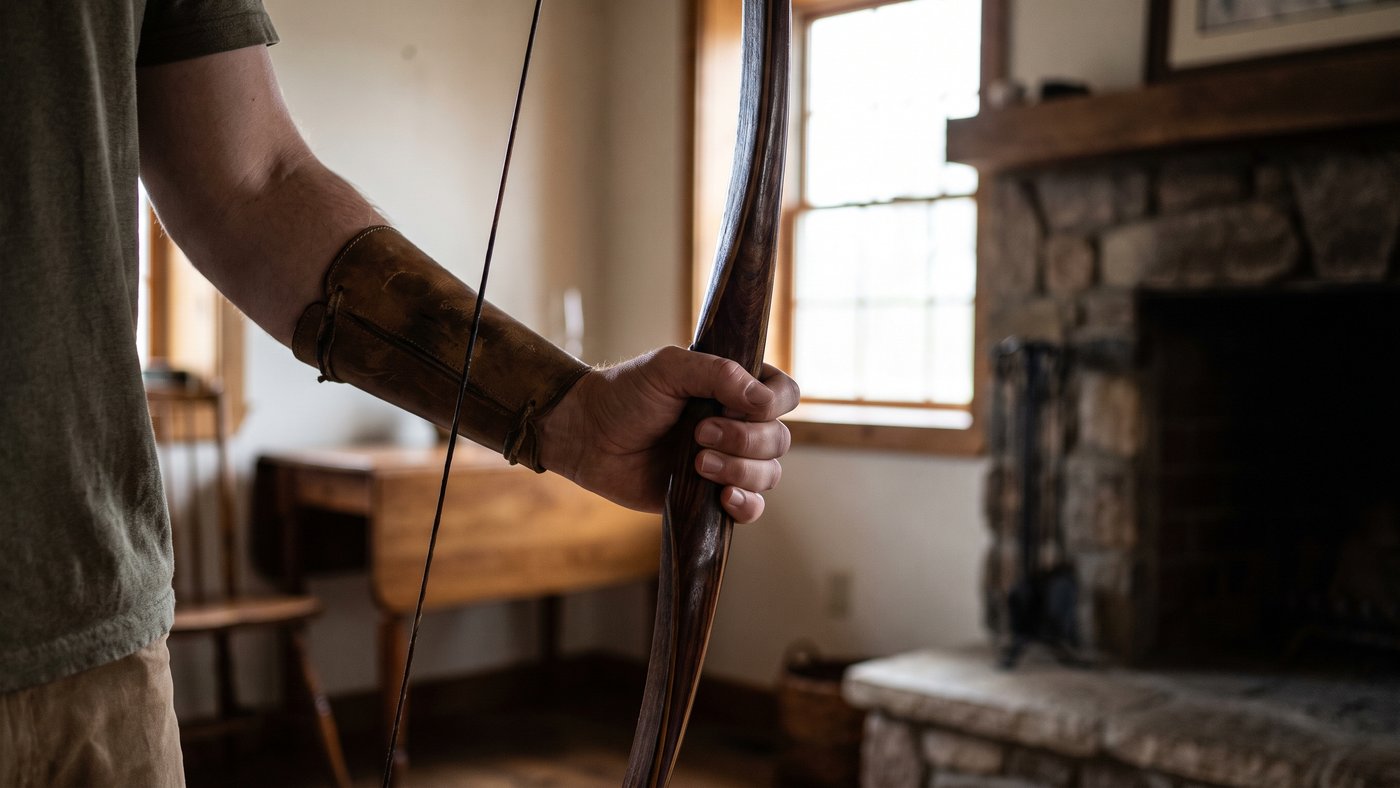
The old rule says a longbow should stand about as tall as you are. It's not wrong, exactly — it's just a proxy for the thing that actually matters, which is your draw length. Two people the same height can draw three inches differently, and it's the draw that decides whether a longbow feels smooth or hits a wall.
Step 1 — Find your draw length
Stand naturally, arms out to the sides, palms forward. Have someone measure fingertip to fingertip — your wingspan. Divide by 2.5. That's your approximate draw length in inches.
A 70-inch wingspan works out to a 28-inch draw, which is the archery industry's reference number for a reason: it's close to average for adult men. If you've ever been measured at a shop with a draw-check arrow, trust that number over the wingspan estimate.
Step 2 — Read the chart
Your draw length Longbow length Under 26" 64" – 66" 26" – 27" 66" – 68" 28" – 29" 68" – 70" 30" and up 70" – 72" When you're between sizes, go longer — a longbow that's slightly long is smooth; one that's slightly short stacks. Notice the height rule hiding inside the chart: a 5'10" archer usually has about a 28-inch draw and lands on a 68–70 inch bow — right around their own height. The chart just gets there honestly.
Why short longbows punish you: stacking
Draw any bow far enough past its design and the weight stops climbing smoothly and starts piling on — an extra pound per inch becomes three, then five. That's stacking, and straight-limbed longbows do it earlier and harder than recurves because there's no curved limb tip to keep the string angle friendly.
A stacking bow is miserable to shoot. It feels like the bow slams into a wall right at your anchor, it magnifies every flaw in your release, and it makes you shorten your draw without noticing. That's why the chart leans long: the cost of extra length is a slightly slower bow; the cost of too little is your form.
English longbows vs hybrids
The chart above fits the modern American-style flat longbow and reflex-deflex hybrids — the bows most people actually buy. A true English longbow, with its deep D-section, wants even more length: traditionally your height plus a hand's width or more, and warbow shooters go well past that.
Hybrids with mild reflex-deflex profiles are the most forgiving of the bunch and the most tolerant of sitting one size off. If you're between a hybrid and a straight-stave design, the hybrid is the safer first longbow.
Draw weight, briefly
Length sorted, weight is the other axis: most adults starting traditional archery shoot best at 35–45 lb, and heavy hunting weights come later, if at all. Longbow weights are marked at 28 inches, and you gain or lose roughly 2–3 lb per inch of draw either side of that. Our draw weight guide covers the details — the short version is that nobody ever regretted starting too light.
What length string does a longbow take?
Different rule from a recurve, and this trips people up constantly. A longbow string runs about three inches shorter than the bow's AMO length; a recurve takes four. So a 68-inch longbow wants a 65-inch string, where a 68-inch recurve wants 64.
Longbow AMO length String length Recurve would take 64 in 61 in 60 in 66 in 63 in 62 in 68 in 65 in 64 in 70 in 67 in 66 in Longbow strings are cut ~3 in under AMO; recurves ~4 in. Buy by the bow's marking, not by measuring the old string. If the length isn't stamped near the limb tip, measure the bow unstrung along its face from string groove to string groove, following the curve rather than cutting the corner — that figure is the AMO length. Don't size a new string by laying the old one out flat: a string that's been shot for a season has crept longer, so you'd buy the stretch as well as the string.
Makers who deviate from the convention say so on the product page, so check the listing before ordering. And if you're stringing it after the new string arrives, our longbow care and setup guide covers doing it with a stringer rather than the step-through method that twists limbs.