Olympic Archery Rules & Scoring, Explained Simply
How Olympic archery actually works — the distance, the target, the ring values, and the set-point match system that decides medals. No jargon, just how the sport is won.
By the Archery Care Editorial Team
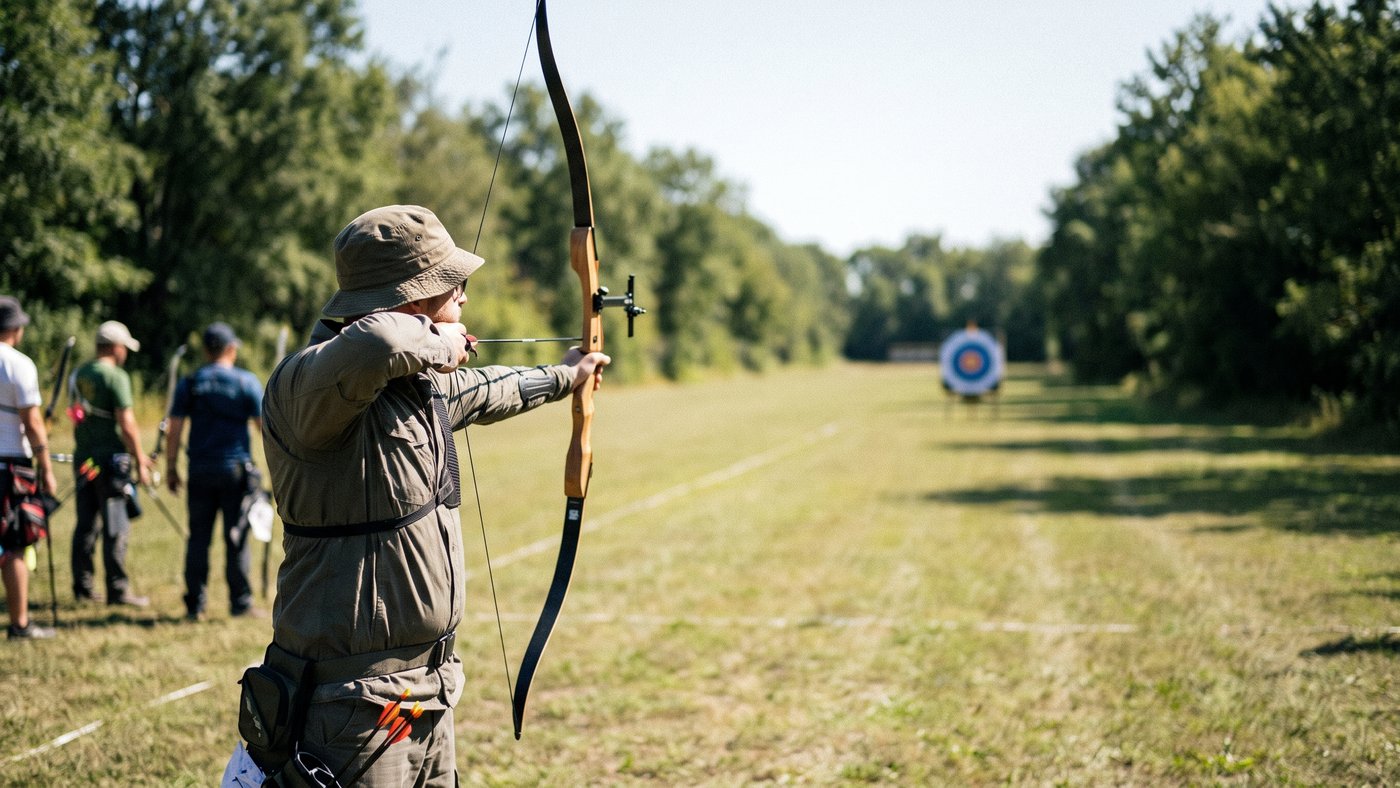
Watch Olympic archery cold and it looks simple: shoot the middle, win. The reality is a two-part event with a scoring twist that trips up every first-time viewer — the archer with the higher total score can still lose the match. Here's the whole system, start to medal.
The distance and the target
Olympic recurve is shot at 70 meters — about 76 yards, or three quarters of a football field. The target face is 122 centimeters across (roughly four feet), which sounds huge until you realize the innermost gold ring is just 12.2 cm — a grapefruit at the length of a swimming pool and a half.
Ten scoring rings, five colors, worth 10 down to 1 from center out:
Rings Color Points Inner + outer center Gold 10 and 9 Next band Red 8 and 7 Middle band Blue 6 and 5 Next band Black 4 and 3 Outer band White 2 and 1 Inside the 10-ring sits an even smaller circle: the X-ring, or inner 10. It still scores 10, but it's the first tiebreaker — count your X's when totals are level.
Part one — the ranking round
Every archer first shoots 72 arrows for score. This doesn't win anything; it seeds the bracket. Top scorer is ranked 1st, and just like a tennis draw, the highest seeds get paired against the lowest in the knockout rounds that follow. A great ranking round buys you an easier early path — nothing more.
Part two — the matches, and the twist
Here's where totals stop mattering. Individual matches are decided by the set system, not by adding up points:
- Each set is 3 arrows. Win the set (higher 3-arrow total) and you get 2 set points. Tie the set and you each get 1.
- First archer to 6 set points wins the match — it's a best-of-five-sets race.
- Level at 5–5 after five sets? One arrow each, closest to the exact center wins. Sudden death, single shaft.
This is why the higher total can lose. Win three sets by a single point each and lose two by a landslide, and you still take the match 6 points to 4. The set system rewards consistency over the occasional monster end — and it makes for far better television.
Teams work the same way, bigger
Team events (three archers) shoot 6 arrows per set and race to 5 set points across a best-of-four. Mixed team (one man, one woman) shoots 4 arrows per set. Same set-point logic, same closest-to-center shoot-off if it's tied — just more arrows in the air and a clock that keeps everyone honest: teams get two minutes for their six arrows, so there's no hiding from the pressure.
One thing that surprises people
Through the Tokyo and Paris Games, the Olympics ran recurve only — the classic sight-and-clicker bow, drawn with fingers, no release aid. Compound archery, for all its popularity in hunting and field competition, makes its Olympic debut at Los Angeles 2028. So when you picture 'Olympic archery,' picture recurve: the discipline our recurve rankings and Olympic equipment guide are built around.